Wired Differently, Dressed Brilliantly: How Neurodivergent Dressers Are Rewriting Britain's Colour Rules
Fashion has rules. You know the ones. Don't mix warm and cool tones. Keep your prints to a maximum of two per outfit. Navy and black together — only if you're very, very careful. Neutrals anchor. Brights should be rationed. These rules exist, supposedly, to create harmony. To make things look right.
But what if your brain doesn't process colour the way those rules assume it does? What if the conventional hierarchy of tones feels not just arbitrary but genuinely baffling — or, conversely, what if your sensitivity to colour and pattern runs so deep that the accepted grammar of dressing simply can't contain it?
Across Britain, a growing number of neurodivergent dressers — people with ADHD, autism, dyslexia, dyspraxia, and other neurological differences — are discovering that getting dressed on their own terms produces something that the rulebook never anticipated: a genuinely new visual language.
The Problem with Neutral
Let's start with what doesn't work — for many neurodivergent people, at least.
The mainstream fashion industry's love of the capsule wardrobe — that serene collection of oatmeal, navy, and grey — is predicated on a very particular relationship with colour. Calm. Considered. Slightly muted. For some autistic dressers, however, that palette isn't calming at all. It's visually flat, unstimulating, and — crucially — it provides none of the sensory feedback that makes clothing feel right.
"I need colour to feel like I exist in my body," says Priya, a graphic designer from Birmingham who was diagnosed with ADHD and autism in her late twenties. "A grey jumper makes me feel like I've disappeared. But if I put on something cobalt blue with a yellow skirt and a green cardigan, I feel completely present. It's almost proprioceptive — the colour tells me where I am."
This is not a fringe experience. Within online communities dedicated to neurodivergent style — on TikTok, in Facebook groups, across Instagram — the conversation about colour as a regulatory tool comes up constantly. Bright colours as grounding. Pattern as a form of focus. Texture as a way of staying connected to the physical world.
Instinct Over Instruction
What makes neurodivergent dressing particularly fascinating from a design perspective is the way it bypasses the learned frameworks that most of us absorb — consciously or not — through magazines, social media, and cultural osmosis.
Many people with dyslexia, for instance, describe a highly spatial, image-led way of processing the world that translates into an almost architectural approach to outfit construction. Colours are placed in relation to each other not according to colour wheel theory but according to an internal logic that's harder to articulate and often more interesting.
"I don't see colours the way the charts say I should," explains Finn, a student from Glasgow who has dyslexia and describes his style as "maximalist by necessity." "I see them in terms of weight and movement. Orange feels heavy to me. Lilac feels like it floats. So I put them together because it creates this tension — something heavy and something light — and it just works. I couldn't tell you why in conventional terms."
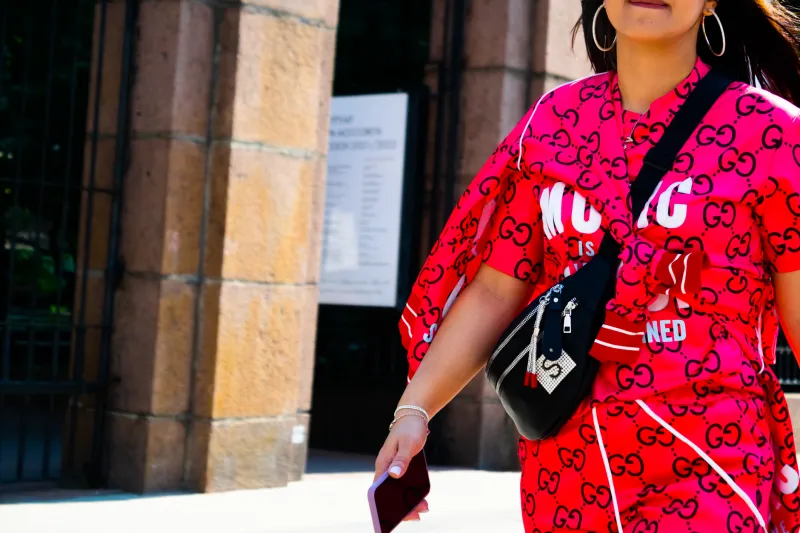
The results, when you look at the style documentation shared within these communities, are genuinely arresting. Combinations that shouldn't work by any conventional measure — terracotta and electric blue, forest green and fuchsia, mustard layered over burgundy with a print that contains both — that somehow do, emphatically and joyfully.
Sensory Dressing as Style Philosophy
For many autistic dressers, the relationship with clothing is filtered primarily through sensory experience rather than visual aesthetics. Texture, weight, and the way fabric moves against skin take precedence over how an outfit looks from the outside. But the sensory requirements and the visual results are often inextricable.
A preference for heavy, substantial fabrics might lead someone toward velvet, brocade, and thick wool — materials that also happen to carry rich colour and pattern particularly beautifully. An aversion to synthetic textures might steer someone exclusively toward natural fibres — linen, cotton, silk — in their most saturated, undyed, or intensely dyed forms.
"My wardrobe looks the way it does because of how my nervous system works," says Jess, a teacher from Bristol who was diagnosed with autism at 34. "But people always ask me about my style like it's a deliberate aesthetic choice. And I suppose it is — just not in the way they mean. I'm not trying to look interesting. I'm trying to feel okay. The interesting is a side effect."
Influencing the Mainstream
It would be easy to frame this as a niche story about a specific community dressing for specific reasons. But the influence of neurodivergent colour sensibility on broader British fashion is becoming harder to ignore.
Independent designers working in the UK's craft and small-batch fashion spaces are increasingly drawing on what might be called an "anti-grammar" approach to colour — deliberately breaking rules in ways that feel energised rather than chaotic. The maximalist revival, the return of clashing prints, the enthusiastic rehabilitation of colours that were previously considered unwearable together — none of this emerged in a vacuum.
Some designers are explicit about the connection. Others simply describe being drawn to a visual energy they can't quite systematise — which is, of course, precisely the point.
When the conventional rules were written, they were written by and for a very particular kind of visual processing. The growing visibility of neurodivergent dressing is a reminder that there are other ways of seeing — and that those other ways of seeing can produce something that the rulebook, for all its confidence, never quite managed to anticipate.
Dressing Without a Rulebook
There's something genuinely liberating in this, even if you're not neurodivergent yourself. The idea that colour rules are a framework rather than a law. That instinct, when you trust it, has its own coherence. That the outfit that makes you feel most like yourself — however chaotic it might appear to someone else — is almost certainly the right outfit.
Britain has always had a complicated relationship with being too much — too bright, too loud, too much. The neurodivergent dressers who are, quietly and brilliantly, rewriting the visual grammar of getting dressed are offering a different proposition entirely.
Being too much, it turns out, might just be exactly enough.