Quiet Loud: The Introverts Dressing as Their Own Inner Universe
Photo: Pedro Ribeiro Simões from Lisboa, Portugal, CC BY 2.0, via Wikimedia Commons
There's a particular kind of magic in watching someone who doesn't especially want to be looked at walk into a room wearing something utterly, arrestingly beautiful. No explanation offered. No eye contact invited. Just a riot of hand-painted florals, or a perfectly considered palette of dove grey and burnt amber, or a single statement brooch the size of a small planet — doing all the talking so its wearer doesn't have to.
This is the quiet revolution happening in British wardrobes right now. And it is, in the most literal sense, spectacular.
The Wardrobe as a Force Field
For introverts — and particularly for those who are neurodivergent, anxious, or simply more comfortable with inner worlds than outer ones — clothing has always served a function that goes far beyond aesthetics. It's architecture. It's boundary-setting. It's a way of shaping how much of yourself you offer up to the world on any given Tuesday.
Rachel, a 34-year-old textile artist from Leeds who describes herself as autistic and profoundly introverted, explains it simply: "I can't always find words quickly. Conversations feel like being asked to perform. But when I'm wearing something I've chosen really carefully, it's like I've already said something true about myself before anyone opens their mouth. It takes the pressure off."
What Rachel wears tends to be extraordinary — layered botanical prints, hand-dyed linen in earthy, storm-washed tones, embroidered details she's added herself. To the casual observer, she looks boldly, defiantly stylish. To Rachel, she looks safe.
This paradox — the introvert in spectacular clothing — is one that fashion psychology has been quietly circling for years. Dr. Harriet Osei, a researcher at the University of Exeter whose work touches on clothing and emotional regulation, notes that "for people who find social interaction effortful or overwhelming, a strong visual identity can function as a kind of script. It pre-answers certain questions, establishes certain expectations, and in doing so, actually reduces the cognitive load of being in public."
In other words: the louder the frock, sometimes, the quieter the anxiety.
Visibility on Your Own Terms
This isn't about hiding. It's subtler, and more interesting, than that.
Many of the introverted dressers we spoke to described a careful, almost architectural approach to controlled visibility — the idea that you can be seen without being exposed. There's a crucial difference. Wearing a coat covered in embroidered moths isn't an invitation to intimacy; it's a declaration of selfhood that requires nothing in return. You're not performing for anyone. You're simply existing, visibly, on your own terms.
Siobhan, a 28-year-old graphic designer from Glasgow, describes her wardrobe as "a mood board that walks around". She gravitates toward muted, dusty palettes — faded sage, old rose, the particular grey-blue of a February sky over the Clyde — punctuated by one unexpected element. A hand-painted silk collar. A pair of Victorian-style boots in deep plum. "I think of it as giving people one thing to look at," she says. "So they're not looking at me."
This idea of the decoy — the beautiful, deliberate detail that draws the gaze away from the self — comes up again and again in conversations with introverted dressers. It's sophisticated, really. Fashion as misdirection. Visibility as camouflage.
The Neurodivergent Aesthetic
For many autistic and ADHD dressers, the relationship with clothing is also deeply sensory. Texture, weight, the way fabric moves — these aren't secondary considerations; they're primary ones. And this sensory attentiveness often produces a style that is, frankly, more considered than anything you'd find on a trend report.
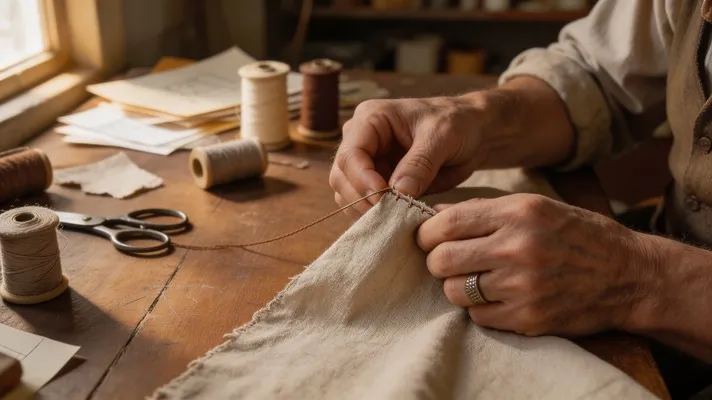
Marco, a 31-year-old illustrator from Bristol, has ADHD and describes himself as someone for whom getting dressed "used to be a nightmare — too many decisions, too much friction". His solution was to build a wardrobe of pieces he describes as "deeply right": things that feel good against his skin, that he never has to think twice about, that are unmistakably his. The result is a quietly distinctive aesthetic built around natural fibres, interesting silhouettes, and a particular fondness for deep jewel tones.
"People always say I look put-together," he laughs. "But it's actually the opposite of effort. I've just done the hard thinking in advance, so I don't have to do it every morning."
This front-loaded intentionality — the hours spent finding the right things so that daily life requires less friction — is a hallmark of the introverted dresser. It looks effortless from the outside. It is, in fact, the product of extraordinary care.
Dressing Deliberately in a Reactive World
Fast fashion, by its very nature, is reactive. It asks you to respond to trends, to seasons, to what everyone else is wearing this minute. For introverts, this is exhausting. The constant noise of it. The implicit pressure to keep up, to be current, to perform a version of yourself that's forever being updated.
Deliberate dressing — choosing slowly, choosing deeply, building a wardrobe that reflects something true and lasting about who you are — is a quiet act of resistance against all of that. It's also, many of the people we spoke to agreed, genuinely joyful.
"I've never bought anything on impulse," says Rachel. "Every piece I own, I know exactly why I have it. That feels like the most luxurious thing in the world."
There's something profoundly Gorjuss about this approach to style — the idea that fashion isn't a performance for others, but a private act of world-building. That your wardrobe is your inner universe, made visible. That the quietest people sometimes have the most extraordinary things to say, if you know how to listen.
And the clothes, it turns out, are always listening back.