What Are You Wearing? No, Really — What Are You Wearing?: Fashion as a Form of Asking
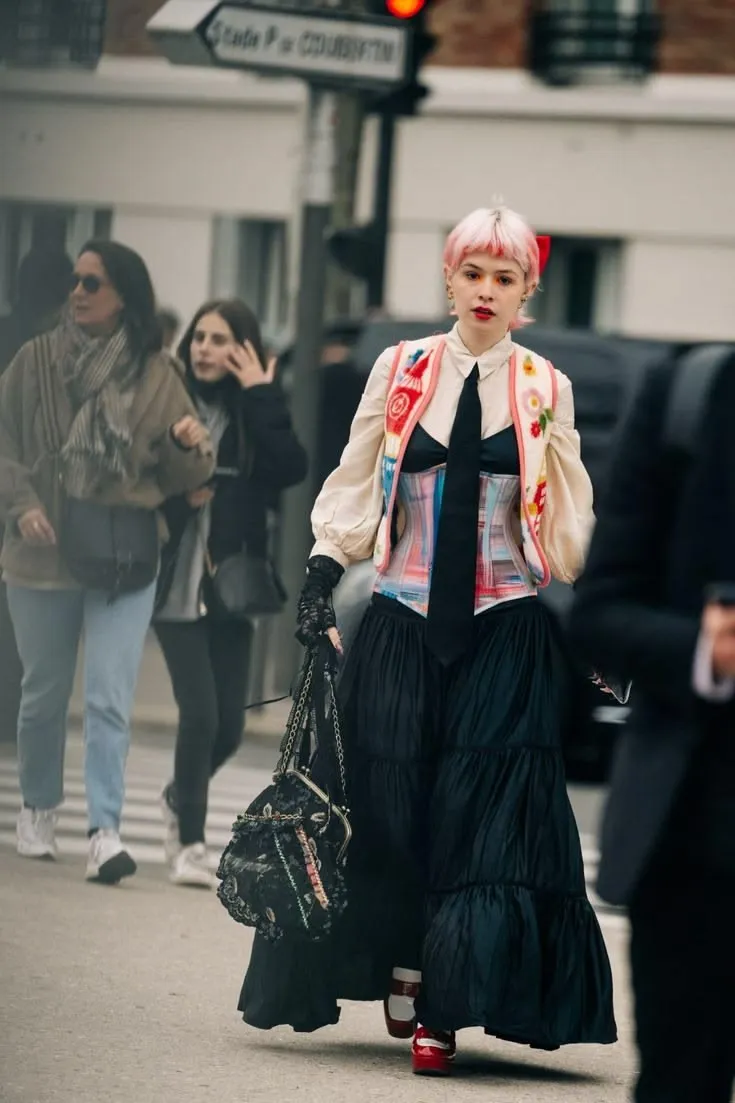
Photo: eclectic quirky British street style fashion curious artistic accessories, via i.pinimg.com
Here is a radical proposition: what if getting dressed wasn't about looking finished?
What if the whole point was to look like you'd left something deliberately unresolved — a loose thread, a strange proportion, an accessory that doesn't quite fit the expected narrative — specifically so that someone might lean forward and say, what's that about, then?
Because that question — that small, curious, slightly delighted question — might be the most interesting thing that happens to you all day.
The Outfit as Opening Gambit
There's a certain kind of dresser you encounter, usually in the kinds of places where interesting things happen — independent bookshops, craft fairs, gallery openings in converted warehouses — who seems to be wearing a question. Not a statement. Not an aesthetic declaration. A question.
Maybe it's the way their jacket is three sizes too large in the shoulders but perfectly fitted everywhere else, creating an alien silhouette that makes you look twice and then a third time. Maybe it's the brooch that appears to be made from a piece of broken crockery. Maybe it's the shoes that seem to belong to a completely different era than everything else, not in a careless way, but in a way that feels specific and chosen and somehow loaded with intention.
You find yourself wanting to ask. And that wanting — that small flicker of curiosity — is exactly what they were after.
"I think about my outfits as conversation starters," says Jonah Fairweather, a secondary school art teacher and inveterate charity shop pilgrim from Leeds. "Not in a showy way. I'm not trying to be the loudest person in the room. I'm trying to be the most interesting question in the room."
Curiosity as a Style Philosophy
Jonah's approach to dressing is less about trends or even aesthetics than it is about inquiry. He asks himself, before leaving the house, not does this look good? but does this make someone want to know more? The distinction sounds subtle. In practice, it produces wildly different results.
"Looking good is sort of... closed," he explains. "It's a complete sentence. You've said the thing, the thing has been received, everyone moves on. But looking curious — wearing something that has a question built into it — that's the start of a conversation. It keeps things open."
This philosophy has produced, over the years, some genuinely spectacular outfits. A Victorian frock coat worn over a contemporary printed sweatshirt. A floor-length skirt paired with a workwear jacket covered in hand-embroidered celestial motifs. A collection of mismatched earrings, each one from a completely different era and aesthetic tradition, worn simultaneously.
None of it is random. All of it is considered. The consideration just happens to look like play.
The Art of the Unexpected Proportion
Over in Manchester, ceramicist and part-time market trader Bea Tsang has developed her own version of this philosophy, one that centres specifically on proportion. She has become fascinated by what happens when you take expected scale relationships and quietly, deliberately subvert them.
"We have such strong intuitions about how things should relate to each other in size," she says. "A bag should be roughly proportionate to the person carrying it. A collar should be roughly proportionate to the garment it's attached to. When you break those rules in a considered way, people's brains do this lovely thing where they can't quite process it immediately — they have to stop and look."
Bea's current obsession is enormous sleeves on otherwise minimal garments. Not as a trend (though it is, admittedly, something of a moment), but as a specific provocation. "The sleeve becomes the question," she says, grinning. "Everything else is just the context for asking it."
Her ceramics work in a similar way — objects that look almost functional but have some subtle wrongness that makes you pick them up and examine them more carefully. The connection between her making practice and her dressing practice is not incidental. Both are driven by the same impulse: make something that demands closer attention.
Wearing Your Reading
For a particular subset of the curiosity dressers, the questions they build into their outfits are specifically intellectual — references to ideas, texts, images, and histories that aren't immediately legible but reward the viewer who looks closely.
Rachel Obi, a PhD student in art history based in London, describes her wardrobe as a kind of portable bibliography. "I'm always wearing something that refers to something I've been thinking about," she says. "Sometimes it's a print that echoes a particular painting. Sometimes it's a colour combination I pulled from an illuminated manuscript. Sometimes it's just a weird brooch I found that seems to contain an entire unexplained story."
The brooch thing is significant. Within the curiosity dresser community — and it is a community, even if a loosely connected one, operating largely through independent fashion platforms, small zines, and the kind of conversations that happen at the right kind of market stall — brooches and pins have become a particularly rich site of inquiry. They're small enough to be overlooked by the casual glance, but specific enough to reward the curious eye. They can carry enormous amounts of meaning in a very small space.
"A good brooch is a whole essay," says Rachel. "You just have to be willing to read it."
The Generosity of the Open Question
There's something genuinely generous about this approach to dressing, when you think about it. The dresser who presents a completed, legible, aesthetically resolved image is, in a sense, doing all the work themselves. They've thought the thoughts, made the connections, arrived at the conclusion, and presented it to you finished.
The curiosity dresser is doing something different. They're leaving space for you. They're building in a gap — a deliberate, inviting gap — where your attention and your imagination can enter.
This feels particularly resonant right now, in a cultural moment when so much of our visual environment is designed to be consumed passively, scrolled past, processed without effort. The outfit that makes you stop and wonder is an act of resistance against that passivity. It's an invitation to be present, to be attentive, to be — for just a moment — genuinely curious about another human being and the world they've assembled around themselves.
Asking Better Questions
At its most expansive, the curiosity dresser philosophy is about more than clothes. It's about how you move through the world. Whether you present yourself as a finished product or as an ongoing inquiry. Whether you're trying to be understood or trying to understand.
The most interesting dressers, in our experience, are always doing both simultaneously — using their clothes as a way of thinking out loud, of processing and questioning and wondering, and inviting anyone who happens to be paying attention to join in.
So next time you're standing in front of your wardrobe wondering what to wear, try asking yourself a different question.
Not: what do I want to say today?
But: what do I want to ask?