From Seed to Seam: The Makers Growing Their Own Wardrobes Out of British Soil
Most of us think about where our food comes from these days. The provenance of a tomato, the story of a loaf of bread — these feel like meaningful things to know. But the provenance of a blouse? The origin of the linen in your favourite summer dress? That's a question very few of us have ever thought to ask.
A quietly extraordinary group of British makers is not only asking it — they're answering it themselves, from the ground up. Literally.
The Garden as Studio
For Ruth Calloway, a textile artist based outside Ludlow in the Shropshire hills, the process begins each March when she sows her flax seed. By July, the field behind her cottage is a rippling sea of pale blue flowers — briefly, heartbreakingly beautiful before the harvest. By the following spring, after retting, scutching, hackling, and spinning, those flowers will have become linen thread. By summer, that thread will be a garment.
"The whole thing takes about eighteen months," she says, holding up a piece of cloth so fine it's almost translucent. "People think that's a long time. But when you wear it, you know every day of it."
That knowing is precisely the point. These aren't clothes you pull on without thinking. They're clothes that carry a complete autobiography — the particular wet spring that slowed the flax, the hot August that rushed the harvest, the winter evenings at the spinning wheel. Every thread is a memory. Every seam is a story.
Dye from the Hedgerow
Growing the fibre is only part of it. For many of these makers, colour is just as important a chapter in the garment's biography — and just as locally sourced.
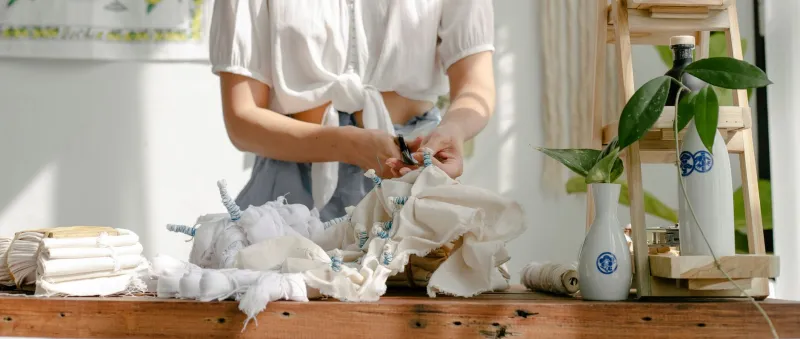
Weld, woad, madder, onion skins, walnut husks, bramble, elder — Britain's hedgerows and gardens are astonishingly rich in natural dye plants, and a new generation of textile artists is learning to read them like a palette. The colours that result are unlike anything you'll find in a fast fashion store: muted, complex, alive in a way that synthetic dyes never quite manage. A yellow from weld has a warmth to it. A blue from woad has a depth. They shift in different lights, fade gracefully with washing, carry the particular character of the soil and water they came from.
Natasha Obi, a maker based in the Wye Valley, has spent three years building what she calls her "colour garden" — a dedicated plot planted entirely with dye species. "My clothes are essentially a map of this valley," she says. "The iron in the water affects the mordanting. The clay soil changes how the madder comes out. Every piece I make could only have come from here."
That hyperlocal quality — the idea of a garment that couldn't exist anywhere else — feels radical in a world of globalised fashion supply chains.
The Mythology in the Making
What strikes you, talking to these makers, is how deeply personal the process becomes. When you've grown something from seed, when you've watched it through seasons, when you've processed it by hand across months of evenings — the resulting cloth carries an emotional charge that's almost impossible to describe to someone who hasn't experienced it.
It's not nostalgia, exactly. Most of these makers are clear that they're not trying to recreate some romanticised agrarian past. They're doing something contemporary and conscious: choosing to understand the full story of what they wear, to take responsibility for every step of it, to let the land they live on speak through the things they make.
"I'm not a historical re-enactor," says Ruth with a laugh. "I wear my linen with trainers and a vintage leather jacket. But knowing the whole story of the cloth changes how I move in it. It changes how I think about getting dressed."
A Growing Movement
The British seed-to-seam community is small but growing, connected by workshops, social media, and a shared sense of purpose. Groups like the Natural Dye and Fibre Network run events across the country. Courses in flax growing and processing are increasingly popular. There's a particular concentration in Wales, where a revival of interest in traditional Welsh wool production has given the movement a regional dimension — young makers learning to work with fleece from Welsh mountain breeds, connecting to a textile tradition that runs centuries deep.
What they're producing, collectively, is a new kind of wearable autobiography. Clothes that know their own origins. Garments that carry not just the maker's story but the story of a particular place, a particular season, a particular piece of British earth.
In a fashion landscape dominated by speed, anonymity, and distance, there's something genuinely radical about a dress that began as a seed in an allotment and ended as something you wear to dinner. Something that says: this came from here. This took time. This is mine in a way that nothing bought ever could be.
The soil, it turns out, has always had stories to tell. These makers are just finally learning to wear them.