The Secrets Sewn Inside: What Britain's Museum Garments Are Whispering to Those Who Listen
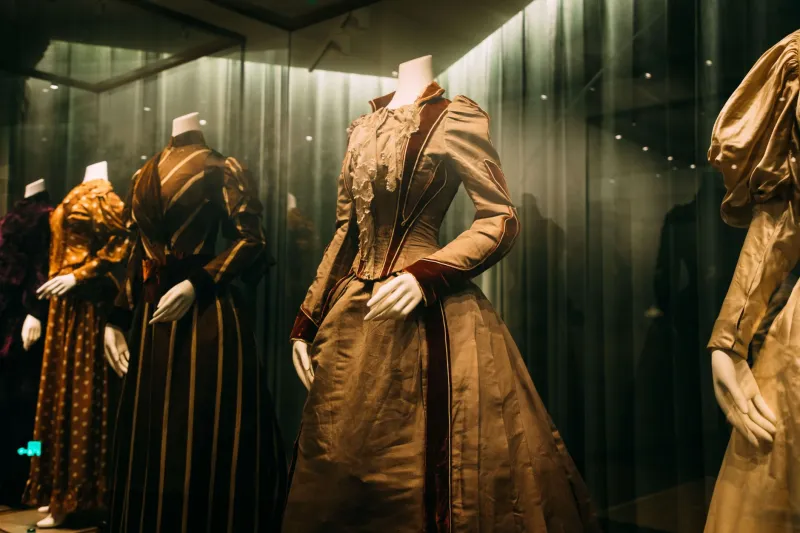
The dress looks, at first glance, entirely unremarkable. Silk, mid-Victorian, a muted dove grey that was probably once a more decisive colour. It sits in a conservation drawer at a regional museum in the north of England, wrapped in acid-free tissue, catalogued and largely unexamined for decades. Then a conservator, preparing it for a new exhibition, notices something beneath the left sleeve seam. A small, folded piece of paper, stitched carefully into a hidden pocket no larger than a playing card.
On it, in faded but legible copperplate, a name and a date. And beneath that, four words: wear this for me.
This is not a fictional account. Stories like this emerge with quiet regularity from the stores and conservation studios of Britain's museums — and the people who find them are becoming some of the most compelling storytellers in the country.
The Work Behind the Glass
Textile conservation is, to put it plainly, one of the most extraordinary professions that most people know almost nothing about. Conservators work at the intersection of science, craft, and history — stabilising fragile fabrics, reversing damage, making invisible repairs — but they also function, inevitably, as detectives.
Because old clothes don't give up their secrets easily. They require patience, magnification, chemical analysis, and the kind of slow, attentive looking that our screen-saturated world rarely demands of us. And when they do reveal themselves, they do so in layers.
A repair technique can place a garment's alteration within a specific decade. A maker's mark stitched into a lining can trace a dress back to a particular workshop in Manchester or a department store in Edinburgh. A stain, examined under ultraviolet light, might reveal the ghost of a perfume or a medicine. The hem of a coat, let down and re-stitched, tells you that someone grew, or that the coat was handed on.
"Every garment is a document," says one conservator working with a major British museum collection. "The difference between a garment and a letter is that the garment doesn't know it's communicating. It just carries the evidence of a life without any editorial control. That's what makes it so extraordinary."
Hidden Architecture
Among the most thrilling discoveries are the structural secrets — the hidden pockets, the concealed compartments, the interior constructions that reveal how women in particular navigated a world that frequently denied them the external pockets that men took for granted.
The hidden pocket is a recurring motif in historic women's dress — and it's one that feels startlingly contemporary. Sewn into side seams, tucked beneath overskirts, concealed within the body of a bodice, these pockets held everything from love letters to small sums of money to devotional objects. Finding one is like discovering a room in a house you thought you knew completely.
At the Museum of London's textile collections, conservators have documented examples of hidden pockets in garments spanning three centuries. In some cases, the pockets still contain objects: a folded piece of ribbon, a tiny key, a fragment of printed cotton that might once have been a keepsake from a market or a fair.
"The hidden pocket is a form of private space," notes one fashion historian who works with the collection. "In a period when women's bodies and movements were heavily surveilled and controlled, the hidden pocket was a small act of sovereignty. I find that incredibly moving — and incredibly relevant."
The Language of Repair
If hidden pockets speak of privacy and agency, the repairs stitched into old garments speak of something equally powerful: the refusal to discard.
Darns in Victorian woollen stockings, so fine they're visible only under a magnifying glass. Silk linings replaced in Georgian coats, the new silk chosen to match the old so closely that only the slightly different weave gives it away. Buttons moved, seams taken in and let out, hems adjusted and re-adjusted over what might have been decades of wear.
This is not the throwaway culture we've inherited. These garments were precious — not always because they were expensive, but because they were needed. The quality of the repair reflects the value placed on the object, and sometimes the skill of the person doing the repairing is astonishing.
For contemporary designers, this language of repair is increasingly inspirational. The visible mend movement — the deliberate, artistic making-visible of repairs using contrasting threads, sashiko stitching, or embroidered patches — draws directly on a tradition that museum conservators have been quietly documenting for years.
"When I show designers what's in the stores, the repairs are always what they respond to most strongly," says one museum professional. "There's something about seeing how much care went into keeping a garment alive that reframes the whole conversation about making and wearing clothes."
Makers, Marked
Not all the secrets are personal. Some are professional — the marks left by the people who made the garments rather than those who wore them.
Maker's marks in historic British clothing range from the formal (embroidered house names in bespoke tailoring, printed labels in department store garments) to the informal and sometimes cryptic: initials pencilled onto a lining in a dressmaker's hand, small chalk marks indicating alterations, pin-prick patterns that preserve the ghost of a fitting.
These marks are a reminder that every garment begins with a person — often an anonymous, underpaid, and under-documented person — whose skill is embedded in every seam. For fashion historians, tracing these marks back to specific workrooms, specific regions, specific periods of labour history is painstaking and politically charged work.
Britain's textile manufacturing history is vast, complicated, and still being written. The marks stitched into museum garments are primary sources in that history — as significant, in their way, as any written record.
Your Wardrobe, Your Archive
All of this — the hidden pockets, the invisible repairs, the maker's marks and personal inscriptions — has implications that extend well beyond museum stores.
If historic garments are documents, then so are your own. The jacket you've had since university, altered twice and repaired once at the elbow. The coat your mother wore before you. The dress you bought for a specific occasion and have worn, slightly differently, ever since.
These things carry evidence of your life in exactly the way that the dove-grey Victorian silk carries evidence of its wearer's. The difference is only time and distance — the museum's authority to say: this matters, look carefully.
Perhaps the most radical thing the textile conservators are doing isn't the science or the detective work or even the exhibitions. It's the quieter invitation they extend to all of us: to treat our own wardrobes as living archives. To notice what our clothes remember. To listen, every now and then, to what they're trying to say.