Bottled Time: The Fragrance Hunters Turning Britain's Charity Shops Into Olfactory Archives
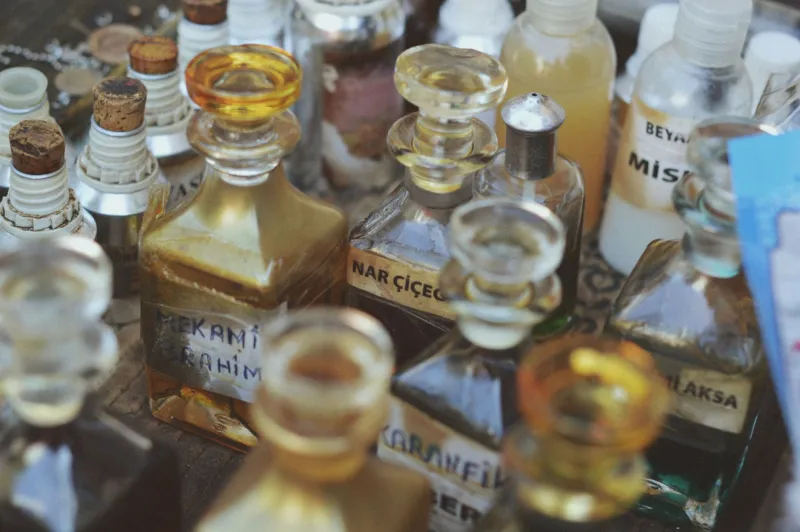
There's a particular kind of magic that happens on a drizzly Saturday morning in a British charity shop. You're flicking through a rail of somebody else's past when your fingers brush against something unexpected — a small glass bottle, amber-coloured, its gold cap slightly tarnished, a label that reads Rive Gauche or Femme or something you've never heard of at all. You uncap it. And suddenly, impossibly, you're somewhere else entirely.
Scent is the most time-travelling of the senses. It bypasses logic and lands you, bodily, in another era. And for a quietly growing community of fragrance enthusiasts across Britain, charity shops, car boot sales, and estate clear-outs have become the most thrilling hunting grounds imaginable — not just for clothes or curiosities, but for bottled history.
The Accidental Archive
Most people don't think of a Cancer Research UK or an Oxfam as a perfume destination. But ask anyone who's been paying attention and they'll tell you: the finds are real, and they're remarkable.
Partial bottles of discontinued Guerlain. Sealed Avon decanters from the 1970s in their original tissue. Yardley talcum powder tins with the powder still inside, smelling faintly of lavender and something more floral underneath — violet, perhaps, or iris. These aren't anomalies. They're a pattern.
When someone passes away or downsizes, their fragrance collection rarely gets the careful consideration their jewellery does. It ends up in a carrier bag with the bath salts and the hand creams, donated without ceremony. Which means that every few weeks, somewhere in Britain, a volunteer is placing a bottle of 1980s Opium or a half-full flacon of Cabochard on a shelf between a ceramic cat and a DVD box set of Midsomer Murders. Waiting.
The Fragrance Archaeologists
Meet the people doing the waiting back.
Online communities dedicated to vintage fragrance have been growing steadily for years — on Reddit, on niche forums, on Instagram accounts with names like @scent_detective and @bottledghosts. But in Britain specifically, the charity shop dimension gives the hobby its own peculiar character. It's democratic. It's unglamorous. It's deeply, wonderfully British.
"I found a bottle of Bal à Versailles in a Sue Ryder in Shrewsbury," says one enthusiast who documents her finds on social media. "It was behind a broken bread bin. The juice had darkened to almost mahogany. And it smelled like the most extraordinary thing — like a ballroom in 1962. I genuinely wept a little bit in the car park."
These aren't just collectors in the conventional sense. Many of them are what you might call fragrance historians by accident — people who became obsessed not just with the scents themselves but with the stories those scents carry. Who wore this? Where did they live? Was this a birthday gift, saved for Sundays, or worn every single day until the bottle ran low?
Regional Scent Trails
One of the more fascinating threads within this community is the observation that charity shop fragrance finds vary noticeably by region — and that this tells its own story about British beauty culture.
In seaside towns, particularly along the south coast and in Norfolk, there's a disproportionate frequency of older, powdery florals — the kind of scents associated with a certain generation of women who dressed for the pier and the promenade. In northern cities, particularly Manchester and Leeds, the finds skew slightly more towards the bold orientals of the 1980s and 90s — Poison, Obsession, Giorgio — reflecting the era's nightclub culture and the relative prosperity of those decades.
Scottish car boot sales, meanwhile, are apparently fertile ground for men's colognes from the 1970s — Old Spice in unusual regional variants, Brut in its original formulation, and occasionally something genuinely rare from a British perfume house that no longer exists.
None of this is scientifically rigorous, of course. But it's the kind of pattern that makes a hobby feel like genuine archaeology.
Textiles That Remember
It isn't only bottles that hold scent. The fragrance hunters will tell you that certain textiles — particularly fur stoles, wool coats, velvet evening bags, and silk scarves — carry olfactory memory in their very fibres. A fox fur from a Barnardo's in Bath might retain, beneath the cedar and the must, a ghost of Chanel No. 5. A 1960s wool coat from a charity shop in Edinburgh might smell, faintly but unmistakably, of Arpège.
For some in this community, the scent-soaked textile is the ultimate find — a garment and a fragrance archive in one. You're not just wearing someone's coat. You're wearing the accumulated sensory history of their life.
Preserving What's Left
There are practical challenges, of course. Old perfume degrades. Alcohol evaporates. Top notes — the lightest, most volatile elements — go first, leaving behind the heavier base notes: the musks, the woods, the resins. This means that a fifty-year-old perfume smells different from its original formulation, but not necessarily worse. Often, enthusiasts argue, it smells better — deeper, stranger, more complex.
Some in the community have begun documenting their finds more formally: photographing bottles, noting provenance where possible, recording what they smell on an improvised scale of their own devising. A few have even begun collaborating with local historians to cross-reference finds with regional department store records, trying to trace which perfumes were sold where and when.
It's a small project, still mostly informal. But there's something quietly radical about it — the idea that the olfactory history of ordinary British life is worth preserving. That the scent a woman in Wolverhampton wore to her daughter's wedding in 1974 is as worthy of documentation as anything in a museum.
Your Wardrobe as a Time Machine
You don't have to become a dedicated fragrance archaeologist to take something from this story. The next time you're in a charity shop — and let's be honest, you're going anyway — slow down at the shelf where the bottles are. Pick one up. Remove the cap. Give it a moment.
You might find something unremarkable. You might find something extraordinary. You might find a scent that opens a door in your mind to somewhere you've never been but somehow recognise.
That's the thing about olfactory time capsules. They don't care whether you're a collector or a casual browser. They just wait, patient and aromatic, for someone curious enough to notice them.
And in Britain's charity shops — those gloriously chaotic, democratically magical spaces — they are waiting right now.