Thread & Thunder: The Subversive Embroiderers Stitching Britain's Quiet Revolution
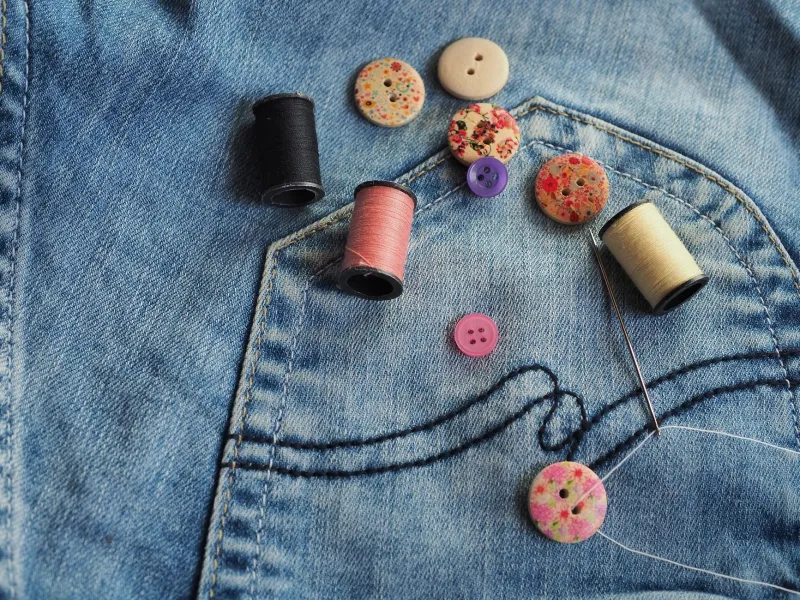
At first glance, the jacket is simply gorgeous. A deep indigo denim, collar and cuffs densely worked in silk thread — flowers, vines, the occasional small bird. The kind of thing you might stop someone in the street to admire. Look closer, though, and the flowers spell words. The birds carry tiny banners. Hidden in the foliage, in letters so small you'd need to lean in, is a sentence from a 1970s feminist pamphlet.
This is the work of Jess, a 29-year-old maker from Sheffield, and it is, she says without drama, entirely intentional.
"I want it to be beautiful first," she explains. "Because beauty gets you close. And once you're close enough to read it, well. That's when the conversation starts."
A History Stitched in Resistance
Embroidery has always had a political dimension, even when history tried to frame it as mere domestic pastime. The Bayeux Tapestry was propaganda. Mary Queen of Scots stitched coded messages during her imprisonment. The Suffragettes embroidered their banners with slogans that were carried through the streets of London and are now housed in museums — quietly extraordinary objects that carried enormous weight.
The idea that needlework is passive, feminine in the diminishing sense, something done in quiet rooms by quiet women — that's a myth that the current generation of maker-activists is gleefully unpicking.
"There's a reason people tried to keep women busy with needles," says Rosa, a textile artist and tutor based in Glasgow. "It was meant to keep us contained. We took the tool and used it to say exactly what we weren't supposed to say. That's not new. We're just doing it louder."
Rosa runs workshops she describes as "stitch circles with attitude" — sessions where participants bring their own text, their own causes, their own urgencies, and learn to work them into fabric. The waiting list is, she notes with some satisfaction, extremely long.
The Coded and the Overt
Within the broader embroidery activism movement, there are broadly two schools. The first is overt — slogans front and centre, nothing hidden, the garment as a placard you can also wear to a dinner party. The second, and arguably more interesting, is the coded approach: messages embedded in pattern, readable only to those who know to look, or who look closely enough.
Both have their advocates. Mina, a community organiser and embroiderer from Birmingham, works entirely in the overt mode. Her pieces feature text in bold, confident lettering — names of women written out of history, statistics, demands. She wants them read from across the room.
"Subtlety has its place," she says, threading a needle with bright red silk. "But sometimes you need the message to be legible at fifteen paces. I'm not making puzzles. I'm making statements."
Contrast this with the approach of Callum, a queer maker from Brighton whose embroidered work is layered with references legible primarily to those within specific communities. A particular flower that carries historical significance. A colour combination with roots in queer history. Symbols that mean nothing to the uninitiated and everything to those who recognise them.
"There's a long history of queer people encoding identity in clothing," he says. "Hanky codes, specific silhouettes, the whole language of subcultural dress. I'm doing something in that tradition — using embroidery to say 'I see you' to the people who need to be seen."
The Garment as Manifesto
What makes embroidered activism particularly interesting as a fashion proposition is its relationship with the object itself. Unlike a slogan tee — mass-produced, disposable — an embroidered piece is slow, labour-intensive, irreducibly handmade. The time spent stitching is itself a form of commitment.
"I spent sixty hours on one piece," says Jess. "Sixty hours thinking about those words, those ideas. That's not nothing. That's devotion."
This slowness also means that each piece is unique, resistant to the copy-and-sell logic of fast fashion. You can't manufacture the embroidery underground at scale. It lives and moves through individual hands, individual choices, one stitch at a time.
Several makers interviewed for this piece spoke about the experience of wearing their work publicly — the encounters it generates, the conversations it starts, the occasional double-take from someone who's just decoded a hidden phrase in your sleeve.
"A woman on the Tube read my cuff," recalls Rosa. "Just this slow realisation crossing her face. She looked up at me and we just — nodded. Didn't say anything. Didn't need to."
Learning to Stitch Back
One of the most energising aspects of this movement is how actively it's teaching itself forward. Workshops, online tutorials, stitch-alongs with political themes — the knowledge is being shared deliberately, generously, with an explicit understanding that the more people who can do this, the more powerful it becomes.
The Embroiderers' Guild, that most venerable of British institutions, has found itself in interesting dialogue with this newer wave. Several younger members are pushing the boundaries of what the Guild considers appropriate subject matter for needlework. The conversations, by all accounts, are lively.
"Some of the older members are brilliant," says Mina. "Genuinely excited by what we're doing. Others are — let's say, more traditional in their view of what embroidery is for. Which is fine. We'll stitch our way through that too."
Wearing the Work
There's a final thing worth saying about embroidered activism, which is simply how beautiful it is. These aren't rough, hurried pieces. They're technically accomplished, often staggeringly so — the kind of work that stops you in your tracks before you've even begun to read what it says.
This is, of course, the point. Beauty is disarming. A gorgeous garment invites attention in a way that a placard doesn't. It gets past defences. It makes you lean in.
And then, once you're leaning in, it says something.
That combination — the aesthetic and the political, the gorgeous and the urgent, the decorative and the defiant — is perhaps the most distinctly gorjuss thing imaginable. Fashion that is genuinely, quietly, magnificently more than it appears.