Dressed in Sound: The British Synesthetes Who Wear Their Senses
Most of us choose what to wear by looking in the mirror. Priya, a 31-year-old textile designer from Bristol, does something altogether more extraordinary. She listens.
"Tuesday always feels like a low, warm amber," she says, pulling a rust-coloured linen jacket from her wardrobe. "And this morning the radio was playing something that tasted of burnt orange. So here we are."
Priya has chromesthesia — a form of synaesthesia in which sounds trigger vivid colour experiences. She's one of a quietly remarkable community of people across the UK whose neurological wiring blurs the boundaries between the senses, and who are, entirely organically, building some of the most fascinatingly personal wardrobes in Britain.
When the Senses Refuse to Stay in Their Lanes
Synaesthesia isn't a condition so much as a variation — an involuntary, automatic joining of two or more sensory pathways that most people experience as entirely separate. One person might see letters as colours. Another might taste shapes. Some feel sounds as physical textures against their skin. Estimates suggest roughly four per cent of the population experiences some form of it, though many go years without realising their perception is unusual.
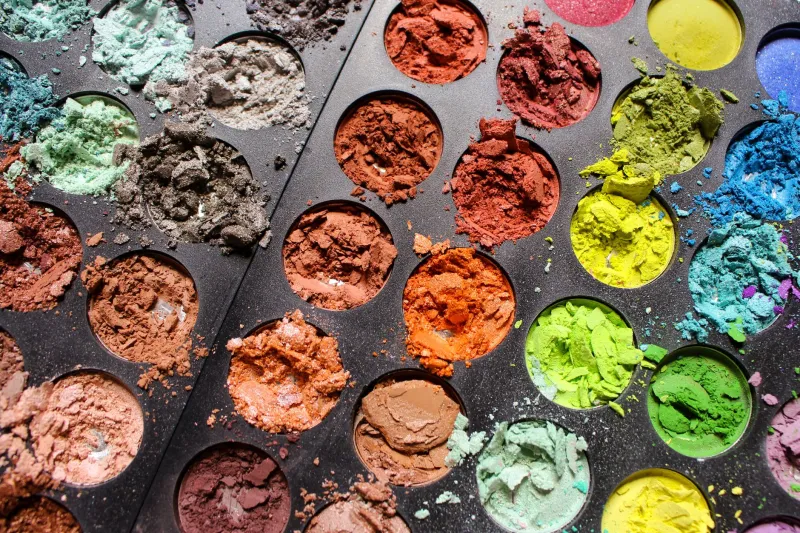
What makes it particularly compelling from a fashion perspective is this: for synaesthetes, colour is never arbitrary. It carries freight. It has temperature, weight, emotional resonance. Choosing a garment isn't just an aesthetic decision — it's a kind of translation.
"I can't wear yellow on days that feel blue," explains Marcus, a musician and part-time vintage dealer from Manchester. "Not because it clashes visually. Because it's wrong in a way I can't explain to people who don't experience it. Like wearing a major key in a minor-key moment."
Marcus has lexical-colour synaesthesia — letters and numbers appear to him in specific, consistent colours. His name is a deep forest green. Mondays are navy. The number seven is a particular shade of dusty lavender that he's spent years trying to match in fabric. He's currently close, he says, with a vintage corduroy from a Salford market.
The Wardrobe as a Sensory Diary
What emerges from conversations with synaesthetes across the UK is that their wardrobes function less like collections and more like ongoing diaries. Each piece holds a sensory memory, a mood-match, a moment that made sense to their particular inner frequency.
Finn, a graphic novelist from Edinburgh, describes his wardrobe as "accidental but absolutely consistent." He experiences emotions as colours — grief is a specific grey-green, joy a fizzing citrus yellow, anxiety a flat, chalky white. His clothes, he laughs, are basically a mood ring writ large.
"People always ask if I dress intentionally," he says. "And I do, just not in the way they mean. I'm not following a colour palette or a capsule wardrobe guide. I'm just... dressing to match what's happening inside."
The results, photographed for this piece, are genuinely striking. Finn's outfits have an internal logic that's difficult to articulate but immediately felt — a cohesion that goes beyond simple colour coordination. There's an emotional grammar to them.
Challenging Fashion's Visual Orthodoxy
Conventional fashion advice is overwhelmingly visual. Colour wheels, skin tone matching, seasonal palettes — all of it assumes that the primary language of getting dressed is optical. For synaesthetes, this logic is at best incomplete and at worst baffling.
"I got told once that I 'shouldn't' wear red and green together," says Zoe, a ceramicist from Cardiff. "But Thursday is red and the word 'garden' is green and on that particular Thursday I was thinking about gardens all day. Of course those colours went together. They are each other, in my head."
Zoe's synaesthesia is spatial-sequential — she experiences time and numbers as physical shapes in the space around her — but she also has a secondary form in which certain words and names carry strong colour associations. Her wardrobe is a riot of combinations that break every conventional rule and somehow work magnificently.
This is perhaps the most radical thing about synaesthetic dressing: it dismantles the authority of external fashion logic entirely. Trend forecasters, style guides, the whole apparatus of telling people what goes with what — none of it maps onto a sensory experience that is, by definition, entirely individual.
Finding Community in Shared Strangeness
For many synaesthetes, discovering that others dress this way is a revelation. Several of the people interviewed for this piece had never connected their wardrobe choices to their synaesthesia until quite recently.
"I just thought I had weird taste," admits Priya. "It took me until my late twenties to realise I wasn't dressing badly — I was dressing in a completely different language."
Online communities have helped. Small, warm corners of the internet where people share their colour-sound mappings, their texture-emotion crossings, their attempts to find the exact fabric that matches the feeling of a particular piece of music. It's niche, but it's growing.
What strikes you, spending time in these spaces, is how much genuine joy there is in them. The frustration of being misunderstood — by shops, by stylists, by well-meaning friends who don't understand why you can't just wear the beige — is real. But so is the delight of having a wardrobe that is, at its core, a direct expression of your most interior self.
The Most Personal Wardrobe in the Room
Fashion talks endlessly about authenticity, about dressing for yourself, about personal style over trends. Synaesthetes are, perhaps, the people doing this most literally of all — not as a philosophy but as a lived, neurological reality.
Marcus puts it simply: "Every single thing I own means something specific. Not sentimental, not stylistic. Sensory. It's mine in a way that nothing bought off a trend report ever could be."
There's something deeply gorjuss about that, actually — the idea that the most extraordinary wardrobes aren't built by stylists or informed by runways, but assembled, piece by careful piece, in conversation with the most private, most vivid, most genuinely personal version of how you experience the world.
Next time someone's outfit stops you in the street and you can't quite explain why it works so brilliantly, consider the possibility that they're not following any rule you'd recognise. They might simply be dressed in a frequency you can't quite hear.