Spangles & Sawdust: The Passionate Collectors Rescuing Britain's Fairground Heritage One Sequin at a Time
Spangles & Sawdust: The Passionate Collectors Rescuing Britain's Fairground Heritage One Sequin at a Time
In a climate-controlled storage unit on the outskirts of Bristol, between a rolled canvas banner advertising a long-vanished strongman act and a rack of moth-carefully-preserved Victorian showgirl bodices, Danny Cartwright is holding a single sequin up to the light. It's the size of a two-pence piece, hexagonal, and a colour that he describes as "between copper and flame — you don't see it made anymore." He's been collecting fairground costume and textile ephemera for eleven years. He shows no signs of stopping.
"People think fairgrounds are just rides and candyfloss," he says, carefully returning the sequin to its archival envelope. "But the visual culture of the travelling fair is one of the most sophisticated and underappreciated design traditions in British history. Every piece of it was made to dazzle, to arrest attention, to make you believe in something impossible. That's not nothing. That's everything."
A Heritage Written in Spangles
Britain's travelling fairs have roots stretching back to medieval charter fairs, but the visual language that most collectors find themselves drawn to emerged primarily in the Victorian and Edwardian periods, when the arrival of the fair in town was genuinely one of the most spectacular visual events most people would encounter in a year.
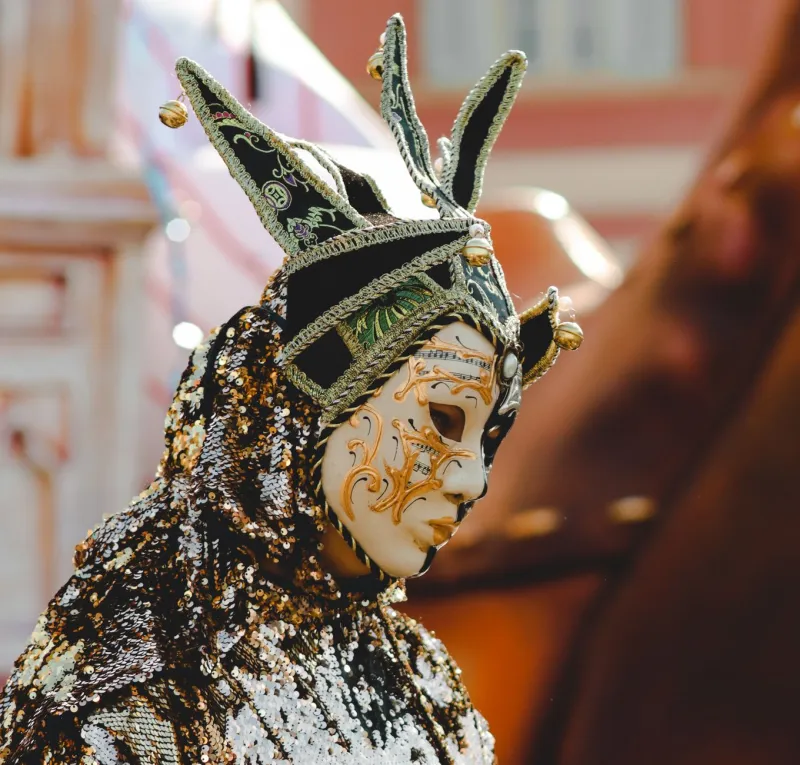
The costumes worn by performers — acrobats, fortune tellers, showgirls, illusionists — were engineering feats as much as fashion statements, designed to catch gaslight and later electric light, to read from distance, to communicate character and mystery simultaneously. Hand-applied sequins and mirrors. Silk in colours that had no equivalent in everyday life. Embroidery so dense it created its own topography. And all of it made, often by the performers themselves or by specialist theatrical costumiers, with an ambition entirely disproportionate to the economics of the travelling life.
The canvas banners that advertised sideshows represent an equally rich tradition — hand-lettered and hand-painted by skilled sign writers who developed their own visual grammar of bold outlines, impossible perspectives, and colours saturated to the point of hallucination. Many of the most accomplished were never signed. Most no longer exist.
The Collectors
Danny is part of a loose national network of people working to preserve what remains. Some are primarily archivists — building photographic and material records of pieces that are increasingly scattered or at risk. Others are active users of what they find, incorporating vintage fairground pieces into their own creative practices or selling to designers who share their obsession.
Among the most significant figures in this community is Ros Tamblyn, a textile historian based in Brighton who has spent two decades documenting the costume traditions of British travelling families. Her archive — which she describes with characteristic understatement as "quite large now" — includes over three hundred garments and fragments, ranging from a complete Victorian fortune-teller's ensemble in red silk and gold braid to a collection of hand-stitched sequin appliqués removed from a 1960s fairground costume that was too damaged to preserve whole.
"What strikes you, working with this material, is the quality of the making," she says. "These weren't throwaway items. They were made to last, because replacing them was expensive and difficult on the road. The embroidery on some of these pieces is extraordinary — the kind of skill level you associate with haute couture, applied to a costume that was going to be worn three shows a night in a tent."
Ros has worked with several independent British fashion designers who've come to her archive seeking inspiration, and she's watched the influence of fairground aesthetics filter into contemporary design with something between satisfaction and mild anxiety. "I want it to be used. I want it to be celebrated. I just want it to be understood, too — there are real people and real traditions behind every one of these pieces."
From Archive to Atelier
The influence of Britain's fairground heritage on contemporary fashion is already visible to those paying attention. It appears in the bold, hand-lettered typography showing up on independent label branding and printed garments. In the unabashed use of sequins and mirrors in non-eveningwear contexts — daytime jackets, market bags, hair accessories — that rejects the idea that dazzle should be rationed. In the return of silhouettes that reference the performative, corseted drama of Victorian showgirl costume, reinterpreted for modern bodies and modern lives.
London-based designer Kezia Moore has been drawing on fairground visual culture explicitly for the past two collections. Her most recent line includes a series of hand-embroidered denim jackets featuring motifs lifted directly from vintage fairground banner lettering — bold, outlined, slightly imperfect in the way that hand work always is. They sold, she says, faster than anything she's made before.
"There's a hunger for something vivid and handmade and historically grounded," she explains. "People are tired of clothes that have no story. Fairground culture is all story. It's the most story-dense visual tradition I know."
Accessories designer Marcus Webb, who works from a studio in Manchester, has been creating a line of embroidered bags and belts using techniques he learned partly through conversations with Ros Tamblyn and partly through his own obsessive study of Victorian theatrical costuming. His signature is a dense, mirror-work embroidery style that references the Mughal-influenced decorative traditions that filtered into British fairground costume through the nineteenth century — a reminder that the travelling fair was always, at its best, a place where cultures met and mixed and made something new together.
Wearing the Wonder
For anyone wanting to bring a piece of this heritage into their own wardrobe, the first rule is to abandon restraint. Fairground aesthetic is not about subtlety. It's about the moment when someone looks at you and feels, just briefly, that something impossible might be true.
Sequins in daylight. Embroidery dense enough to be its own artwork. Bold lettering on fabric. Silhouettes with drama — a full skirt, a nipped waist, a sleeve with genuine presence. Colours that don't apologise: deep crimson, electric teal, the particular gold that exists only on fairground signage and nowhere else in the world.
Buy from independent makers and small labels who are doing this work thoughtfully — who understand the tradition they're drawing from and are adding to it rather than simply mining it. Seek out vintage pieces where you can find them: theatrical costumiers, specialist vintage dealers, the occasional miraculous charity shop find.
And if you ever get the chance to visit a collector like Danny or Ros, take it. Stand in a room full of the things that were made to make people believe in magic, and feel what happens to your sense of what's possible.
Then go home and put on something that dazzles. The fair is always, somewhere, in town.