Ribbons, Horns & Living Memory: The Young Makers Refusing to Let Britain's Folk Costume Die
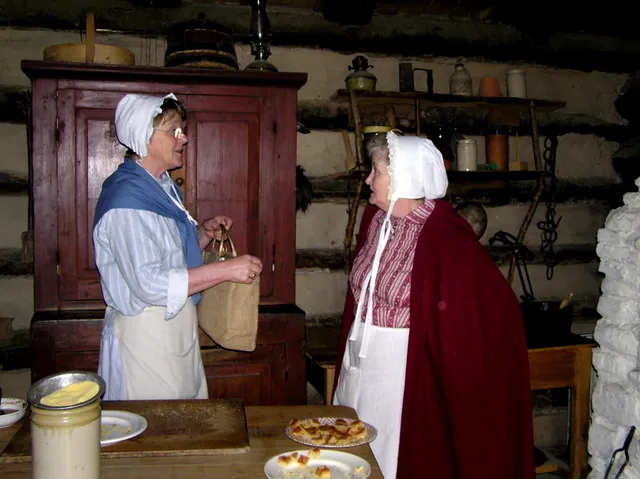
Photo: Kenneth Allen , CC BY-SA 2.0, via Wikimedia Commons
Ribbons, Horns & Living Memory: The Young Makers Refusing to Let Britain's Folk Costume Die
The Mari Lwyd arrives after dark. She comes with a skull — a real horse's skull, jaw wired to snap, eye sockets lit from within — carried on a pole beneath a white sheet, adorned with ribbons and rosettes and trailing fabric, attended by a small group of singers who will stand outside your door and attempt to out-rhyme you before you let them in. It is one of the oldest midwinter customs in Wales, probably pre-Christian in origin, and it is, by any measure, absolutely extraordinary.
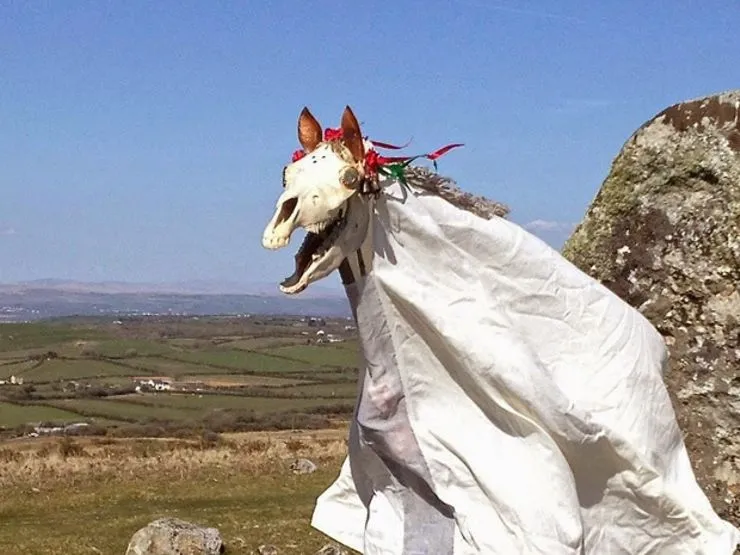 Photo: Mari Lwyd, via orion-uploads.openroadmedia.com
It is also, quietly, in peril.
What Is Being Lost
Britain's folk costume traditions are not the cosy, sanitised heritage that tourist brochures tend to suggest. They are genuinely strange — rooted in pre-industrial ritual, shaped by local geography and community memory, and often carrying a darkness that has nothing to do with heritage centres or gift shop postcards. The Abbots Bromley Horn Dance, performed each September in Staffordshire, sees twelve dancers carrying reindeer antlers that are over a thousand years old. The Molly dancers of East Anglia wear grotesque, painted faces and deliberately chaotic clothing. The Hoodening of Kent involves another horse skull, another sheet, another set of attendants who have been doing this — with gaps and interruptions — for centuries.
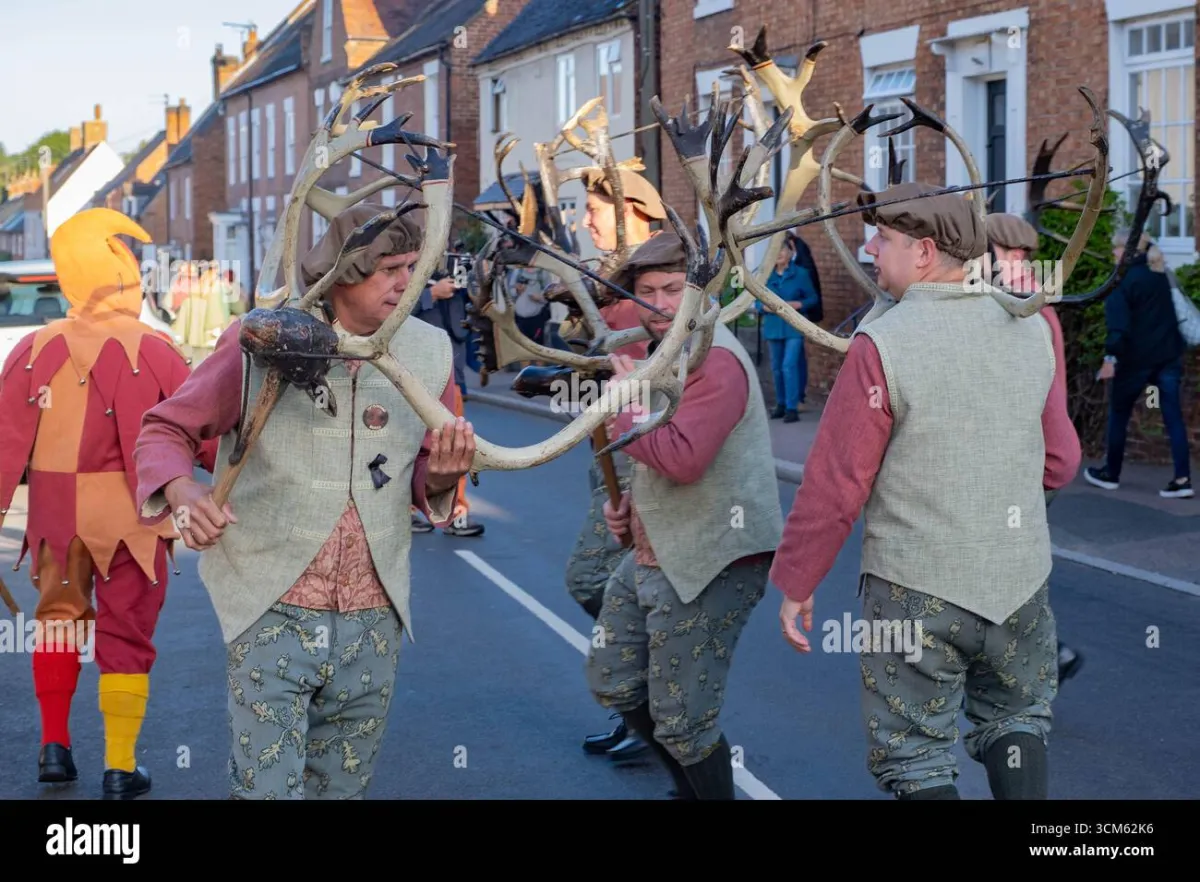 Photo: Abbots Bromley Horn Dance, via c8.alamy.com
These traditions survive, when they survive, through community transmission — knowledge passed person to person, costume made and remade by hand, the whole fragile apparatus depending on people who care enough to keep going. And in many places, the chain has broken, or is close to breaking.
"There are traditions that were dormant for fifty, sixty years and have been revived," says Caitlin, a costume maker and folk researcher based in Shropshire who has spent the last decade working with communities to reconstruct lost ceremonial dress. "And there are others that are genuinely on the edge. One or two people who hold the knowledge, and when they go, it goes."
The New Keepers
What is changing — and what makes this moment feel genuinely hopeful — is the nature of the people now taking up the work. A generation of young makers, performers, academics, and artists have found their way to folk costume through routes that have nothing to do with traditional heritage pathways. Some come from fashion. Some from theatre. Some from textile art or natural dyeing or embroidery. Some simply stumbled across a YouTube video of the Mari Lwyd and felt something shift.
"I was doing a fashion degree and completely disillusioned with the industry," says Rosie, who now makes ceremonial costumes and runs workshops on folk textile traditions in the West Midlands. "I found folk costume and it answered something I hadn't known I was asking. Here was clothing that meant something. That was for something. That existed in a community context, not a commercial one."
This is a distinction that comes up repeatedly when you talk to people working in this space. Folk costume is, by definition, collective — it exists in relation to other people, to a place, to a time of year, to a set of shared meanings. It is the opposite of personal branding. And for a generation that has grown up inside the relentless individualism of social media fashion, that collectivity feels, paradoxically, like a radical act.
Making as Research
The practical work of folk costume revival is painstaking. Traditions that have been dormant leave fragmentary records — old photographs, parish accounts, the occasional surviving garment in a local museum's storage. Reconstructing a costume means becoming a detective: cross-referencing sources, consulting with local historians, speaking to elderly community members who remember watching a tradition as children.
Caitlin describes working with a Shropshire community to reconstruct a local plough Monday tradition that had lapsed in the 1960s. "We had three photographs and a description in a Victorian county history," she says. "Everything else was interpretation. But that's also where the making becomes creative — you're not copying, you're continuing. You're making decisions that the people who made these costumes originally were also making, based on what was available, what felt right, what the community needed."
The materials matter enormously. Many folk costumes were made from whatever was at hand — strips of rag, recycled fabric, natural dyes from local plants. Contemporary makers working in this tradition often choose to honour that material logic, using undyed wools, plant-dyed linens, and reclaimed fabric in ways that connect the work to its ecological roots as well as its cultural ones.
What Ancient Dress Teaches
There is a fashion argument to be made here, and it is not a nostalgic one. Folk costume is, at its core, a sophisticated visual language — one that encodes community identity, seasonal rhythm, and collective mythology in colour, pattern, and form. It is the oldest kind of meaningful dressing, and it asks questions that contemporary fashion rarely bothers with: What is this clothing for? Who is it with? What does it mean?
"Fast fashion gives you the feeling of having a self through what you wear," says Rosie. "Folk costume gives you the feeling of belonging to something larger than yourself. Those are completely different relationships with clothing, and I think a lot of people are hungry for the second one without quite knowing it."
The visibility of folk traditions — even endangered ones — has increased sharply in recent years, driven partly by social media accounts documenting ceremonies, partly by a broader cultural turn toward the local and the rooted, and partly by the efforts of people like Caitlin and Rosie who are simply showing up and doing the work.
The Skull, the Ribbons, the Antlers
The Mari Lwyd will come again this winter. In Llangynwyd, in Maesteg, in a growing number of Welsh communities where the tradition has been revived by people who found the horse skull and the snapping jaw and the ancient wassailing custom not frightening but necessary. The ribbons will be made by hand. The sheet will be carefully folded and unfolded. Someone will stand at a door in the cold and begin to sing.
And somewhere, a young maker will be watching — notebook in hand, phone in pocket, already thinking about what they might contribute. Already asking what it means to dress not for themselves, but for everyone.
That question, it turns out, is as old as the hills these traditions walk.