Mismatched & Magnificent: Why Britain's Tea Rooms Are Quietly Running Fashion's Most Enchanting Trend Lab
Mismatched & Magnificent: Why Britain's Tea Rooms Are Quietly Running Fashion's Most Enchanting Trend Lab
Forget the concept store. Forget the gallery opening. If you want to understand where a genuinely interesting corner of British fashion is heading right now, order a pot of Darjeeling, ask for the cake stand, and look around you very carefully.
Britain's independent tea rooms — the ones with the slightly wobbly tables and the china that doesn't match and the handwritten menus in a font that someone's nan developed over decades of practice — are having a moment. Not as Instagram backdrops (though they are, inevitably, that too), but as serious creative pilgrimage sites for designers, print makers, and fashion-curious people who've grown tired of the relentless minimalism that dominated the last decade.
The Visual Language of the Afternoon
There's a specific aesthetic grammar at work in the best British tea rooms, and once you start noticing it, you can't stop. It's built from accumulation rather than curation — layers of pattern, colour, and texture that have arrived over years without anyone necessarily intending them to work together, and yet somehow they do, magnificently.
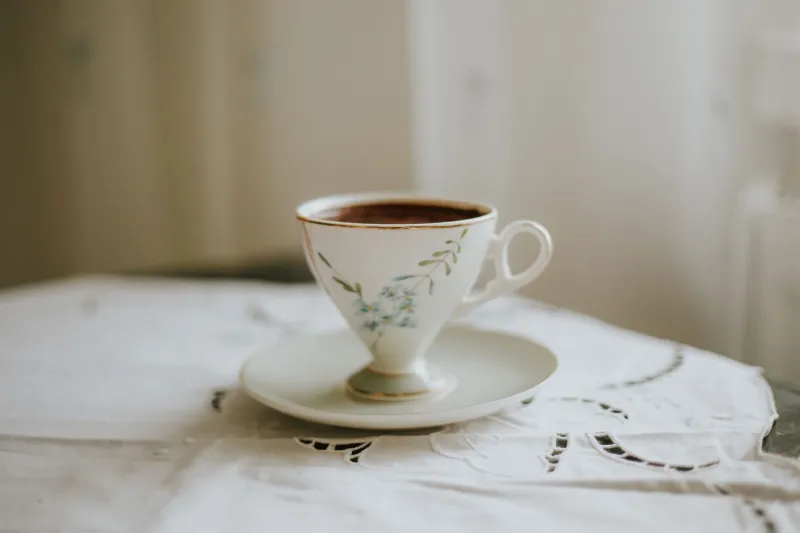
A tablecloth in faded pink roses sits beneath a cake stand painted with hand-applied gold leaf. The wall behind carries a William Morris print in teal and rust. The teacup in your hand is decorated with a pattern that appears to be cornflowers, except that the blue has shifted over decades of washing into something closer to lavender. The curtains are a completely different floral entirely. And the whole room hums with a coherence that has nothing to do with a mood board and everything to do with time.
This is the aesthetic that a growing number of independent British designers are actively studying, photographing, and translating into their work. And the results are genuinely beautiful.
The Pilgrimage Begins
Print designer Harriet Faulkner, who sells her fabric collections through a small studio in Bath, has been making what she calls her "tea room tours" for the past three years — deliberate road trips through rural England, seeking out independent tea rooms specifically to study their visual environments.
"I bring a notebook and I draw everything," she says, settled into a corner of a particularly spectacular example in the Cotswolds, where the wallpaper features hand-painted roses in a shade of dusty pink that she's been trying to recreate in dye for six months. "Not to copy it, but to understand how these combinations work. Someone chose this wallpaper without thinking about whether it would 'go' with the tablecloths. And because of that, it does."
Harriet's most recent fabric collection — a run of cotton lawn prints in soft, layered florals with what she describes as "a slight watercolour fading, like they've been washed a hundred times" — sold out to independent dressmakers and small fashion labels within weeks of launching. The inspiration, she says, was almost entirely drawn from a tea room in Ludlow where the china patterns were so varied and so beautiful that she photographed every cup on the table.
From Cake Stand to Catwalk
The specific visual elements of the tea room aesthetic are showing up with increasing frequency in independent British fashion. Faded pastel florals — not the sharp, high-contrast prints of fast fashion, but the soft, slightly desaturated versions that look like they've been left in sunlight — are appearing on everything from midi skirts to wide-brimmed hats. Delicate gold and cream colour combinations, lifted directly from the gilded china tradition, are informing jewellery and accessories. And the layering logic of the tea room — pattern on pattern, texture on texture, nothing too precious about the combinations — is being applied to outfit building in genuinely freeing ways.
London-based accessories designer Priya Mehta cites a small tea room in the Yorkshire Dales as the direct inspiration for her latest collection of hand-painted silk scarves. "The owner had hung vintage embroidered samplers alongside pressed flower pictures alongside a watercolour of the local church," she recalls. "None of it was the same scale or the same style. But the overall effect was this extraordinary richness. I wanted to wear the whole room."
Priya's scarves carry exactly that quality — layered botanical motifs in faded rose, sage, and cream, with tiny hand-applied gold details that catch the light. They look, unmistakably, like something that belongs in a room with a cake stand and a pot that's been warming on the counter since half past ten.
The Art of the Mismatch
Perhaps the most valuable lesson the tea room offers isn't about specific patterns or colours but about the confidence to mix. The mismatched china tradition — which exists in British tea rooms partly by necessity (things break, replacements are sourced from wherever) and partly by a kind of benign aesthetic anarchy — gives permission to combine things that a more rule-bound approach would never allow near each other.
This is genuinely radical in a fashion context. The idea that a Liberty print blouse can sit happily alongside a vintage floral skirt in a completely different colour family, held together by the fact that both carry the same quality of softness, the same gentle fading, the same sense of having been loved for a long time — that's a tea room lesson, and it's one that makes getting dressed considerably more joyful.
Stylist and writer Clara Whitmore, who has been documenting this aesthetic crossover on her newsletter for the past year, puts it simply: "Tea rooms never got the memo about rules. They just kept doing the thing that felt right and comfortable and beautiful. And now the rest of us are catching up."
Finding Your Tea Room Wardrobe
If you want to start building your own version of this aesthetic, the obvious first step is actually visiting tea rooms — not the chain café variety, but the proper independent ones, the ones with the slightly creaking floors and the home-baked scones and the china that tells a story.
Beyond that, look for pieces that carry the quality of gentle age — fabrics with a soft, slightly washed-out quality rather than sharp newness. Mix florals without worrying too much about whether they match. Introduce gold details sparingly, the way a tea room uses it: on a cup rim, on a frame, never overwhelming. And layer textures — linen over silk, cotton voile over jersey — the way those rooms layer their patterns, with cheerful disregard for the rules.
Britain's tea rooms have been quietly perfecting this aesthetic for a century or more. It turns out they've been running a trend lab the whole time. The scones are excellent, and the design education is completely free.