The Fifty Pound Wardrobe: Britain's Charity Shop Chameleons and Their Brilliant Style Secrets
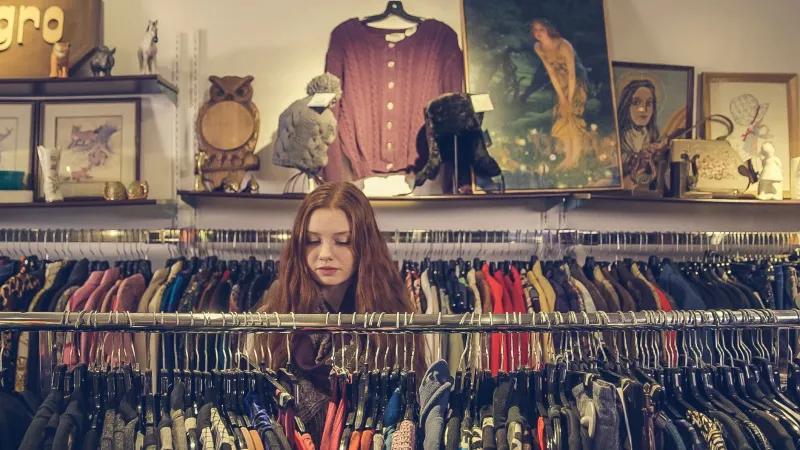
Let's be honest: the most interesting person in any room is rarely the one in the newest outfit. More often, it is the one whose jacket has a story, whose boots have a history, whose entire look seems to have been assembled by someone with extraordinary taste and absolutely no interest in following the obvious path. Nine times out of ten, that person has been to a car boot sale recently.
Britain's secondhand scene is, quietly, one of the most vibrant creative communities in the country. And the people navigating it — the thrift chameleons, the boot sale regulars, the charity shop devotees — have developed a set of skills and instincts that put most high-street shoppers to shame.
Here is what they know.
Rule One: Buy the Feeling, Not the Item
Every experienced secondhand dresser will tell you the same thing: stop shopping for specific items and start shopping for a feeling. When Manchester-based stylist Bex Torrance walks into a charity shop, she is not looking for a blouse or a pair of trousers. She is looking for something that stops her cold.
"If I pick something up and immediately start mentally styling it, that's the sign," she says. "I don't ask 'where would I wear this?' I ask 'who would I be in this?' Those are very different questions."
This shift in mindset is the foundation of the fifty-pound wardrobe. It requires you to let go of the idea that clothes need to be practical first and wonderful second.
The Capsule Formula That Actually Works
For those who want a more structured approach, there is a deceptively simple formula that experienced thrift dressers swear by:
One statement piece + two neutrals + one wild card = a complete outfit.
The statement piece is whatever drew you in — the printed midi skirt, the embroidered blouse, the velvet blazer in an improbable colour. The two neutrals anchor it without dulling it. The wild card is the unexpected element that makes the whole thing feel intentional rather than accidental: a brooch, a scarf worn as a belt, boots in a clashing shade.
Leeds-based content creator Dani Osei has built an entire social media following around this formula, regularly posting outfits assembled for under a tenner. Her secret? "I always buy the wild card first. It's usually the cheapest thing — a scarf, a bit of jewellery — and it gives me a direction for everything else."
Where to Look (Beyond the Obvious)
Oxfam and the British Heart Foundation are wonderful, but the real treasure hunters know to look further afield.
Car boot sales remain the single best source of genuinely cheap, genuinely interesting clothing. Arrive early (seriously, 7am early) and head straight for the stalls run by older sellers clearing out decades of accumulated style. These are the racks where you find the real finds: 1970s knitwear, silk blouses from the 1980s, shoes that were made to last.
Church sales and village fetes are criminally underrated. The stock is often pristine, the prices are laughable, and the competition is virtually nil because most people don't think to look there.
Facebook Marketplace and local selling groups have become essential for anyone in a smaller town where the physical charity shop stock is limited. Search by colour rather than item type — you will find things you never knew you needed.
Specialist vintage markets — Portobello, Spitalfields, the Glasgow Vintage Vehicle Trust fair — are worth the travel and the slightly higher prices for the sheer density of interesting things in one place.
The Art of Transformation
The fifty-pound wardrobe is not just about finding things. It is about seeing what they could become.
Birmingham-based maker Cleo Farrow buys items specifically for their transformation potential. A men's oversized shirt becomes a dress with a belt. A skirt becomes a top with a few strategic tucks. A blazer with tired lining gets the lining removed entirely, becoming something altogether more interesting.
"I've got a rule: if I can't think of at least two ways to wear something differently from how I found it, I leave it," she says. "The best pieces in my wardrobe are the ones that have been three or four different things."
Basic sewing skills — hemming, taking in seams, replacing buttons — multiply the value of everything you find. A £2 dress that needs taking in is not a problem. It is an opportunity.
The Psychology of the Overlooked
There is something genuinely transformative about learning to see potential in things other people have passed over. It changes not just how you shop but how you see.
Psychologist and vintage enthusiast Dr. Preet Malhotra, who has written about the mental health benefits of creative thrifting, describes it as "a practice in generosity of imagination. You extend the same benefit of the doubt to a slightly scuffed shoe or an unfashionable print that you would want someone to extend to you on a bad day."
There is also, she notes, a genuine pleasure in the hunt that fast fashion simply cannot replicate. The dopamine hit of finding something extraordinary in a pile of ordinary things is, she suggests, "the closest most of us get to the feeling of discovering buried treasure."
The Fifty-Pound Challenge: A Starting Point
If you want to try building your own thrift wardrobe, here is a suggested budget breakdown to get you started:
- £15 — one statement piece (a jacket, a dress, a coat with personality)
- £10 — two neutral basics (a plain tee, simple trousers, a white shirt)
- £10 — footwear (always worth spending slightly more here for quality)
- £8 — one wild card accessory (brooch, scarf, unusual bag)
- £7 — held in reserve for the thing you didn't expect to find
The rules are loose. The fun is mandatory. And the results, as Britain's most creative dressers will tell you, are almost always better than anything you could have planned.