After Hours, After Hours: The Fashion Devotees Who Find Their Muse in the Museum Dark
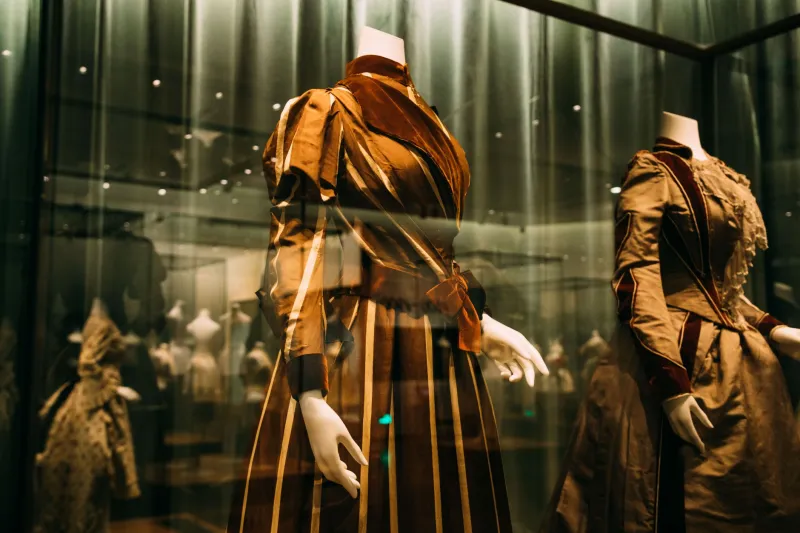
The building is quiet now. The school groups, the tourists with their audio guides, the children pressing their faces against glass cases — all gone. The galleries hold a different quality of silence in the evening, something that feels almost like held breath.
And here, in the conservation store of a regional museum in the north of England, Eleanor is holding a 1780s mantua with the careful reverence of someone handling something sacred.
"There's a repair here," she whispers, tracing a near-invisible seam with a gloved finger. "Someone mended this. Wore it again after. I think about that person a lot."
Eleanor volunteers two evenings a week, assisting with catalogue work and condition checks on the museum's textile collection. She is not a fashion professional. She is, by day, a secondary school geography teacher. But in these quiet hours, she is something else entirely: a student of the most intimate kind of history, and one of a remarkable community of people across Britain who are finding their deepest creative inspiration in the closed, after-hours spaces of our great cultural institutions.
The Other Side of the Velvet Rope
Most of us experience museum costume collections through glass — or, if we're lucky, through a well-lit exhibition with accompanying wall text. What we rarely see is the archive behind the archive: the flat-file drawers and acid-free boxes, the rolling rails of garments wrapped in tissue, the shelves of accessories catalogued but rarely displayed.
For those who work or volunteer in these spaces, this hidden collection is the real education.
"The stuff on display is extraordinary," says Tom, who volunteers at a historic house in Yorkshire with a significant eighteenth-century dress collection. "But the stuff in storage — things that haven't been exhibited in decades, things that are too fragile or too damaged — that's where you find the really interesting stories."
Tom came to volunteering through a general interest in history. He stayed, he says, because of a waistcoat. A 1740s embroidered silk waistcoat, slightly moth-eaten, with a repair so beautifully executed that it was almost indistinguishable from the original work.
"It changed how I think about my own clothes," he says. "The idea that something worth wearing is worth repairing. That a mend can be as skilled and considered as the original making. I started mending my own things differently after that."
Scholarship by Lamplight
What these after-hours enthusiasts are doing doesn't fit neatly into any existing category. They're not academics, not professional conservators, not fashion historians in the formal sense. But the knowledge they accumulate — through direct, tactile, sustained engagement with historical garments — is genuinely profound.
Sadie works evening shifts in the textile archive of a large city museum in the Midlands. She has, over three years of volunteering, developed a working expertise in nineteenth-century cotton prints that she describes as "completely accidental and absolutely obsessive."
"I can date a cotton print to within about a decade now just from the repeat size and the colour registration," she says, with the slightly surprised air of someone who has discovered an unlikely superpower. "I never set out to learn that. I just kept looking."
This sustained, unhurried looking is, several people interviewed for this piece suggest, only possible in the after-hours quiet. During opening hours, even behind the scenes, there's a pace and a purpose — visitors to assist, events to support, colleagues to coordinate with. In the evenings, there is time to simply be with the objects.
"You can spend forty minutes with one glove," says Eleanor. "Just looking. Thinking. Following the logic of how it was made. You couldn't do that in the daytime."
From Archive to Outfit
The translation from museum study to personal style is rarely direct — nobody is going home and recreating a Georgian robe à la française for their commute. But the influence is real, and it runs deep.
Sadie's wardrobe has, she says, become increasingly print-led over the three years of her archive work. She's developed a particular love for small-scale geometric repeats — "the kind of pattern that reads as almost plain from a distance but absolutely sings up close" — that traces directly to her work with Victorian cotton samples.
"I started noticing different things in shops," she explains. "I'd pick something up and think about the repeat, about whether the colours had been thoughtfully placed. I got much more demanding, actually. In a good way."
Tom has become, he admits, mildly evangelical about visible mending. The waistcoat that started it all has led him to a practice of deliberate, skilled repair that he now considers one of the most satisfying things he does.
"People comment on my clothes now in a way they never used to," he says. "Not because I'm wearing anything expensive or fashionable. Because there are interesting things to look at. Stories, if you know where to look."
The Institutions Opening Their Evenings
It's worth noting that this kind of access doesn't happen by accident. Museums and historic houses that open their collections to volunteers — particularly evening and weekend volunteers who assist with behind-the-scenes work — are providing something genuinely rare: the opportunity for non-specialists to develop deep, direct relationships with material culture.
Several UK institutions have expanded their volunteer programmes in recent years, partly driven by resource constraints and partly by a genuine philosophical commitment to widening access to collections. The results, in human terms, are people like Eleanor and Tom and Sadie: self-taught experts with a passion that no formal curriculum could have generated.
"The museum gave me this," says Eleanor simply. "Not deliberately, not as a programme. Just by letting me be here, in the quiet, with the things."
The Quiet Glamour of the After-Hours
There is something undeniably romantic about this — the hushed galleries, the lamplight, the tissue-wrapped treasures in their flat files. Something that feels, in the best possible way, like a secret.
And perhaps that's the most gorjuss thing about it: the idea that some of Britain's most genuinely inspired fashion thinking isn't happening in studios or showrooms or at fashion weeks, but in quiet museum storerooms on Tuesday evenings, in the company of a 250-year-old glove and someone with nowhere else they'd rather be.