Wonky Is the New Wonderful: Why British Fashion Is Falling Gloriously Out of Line
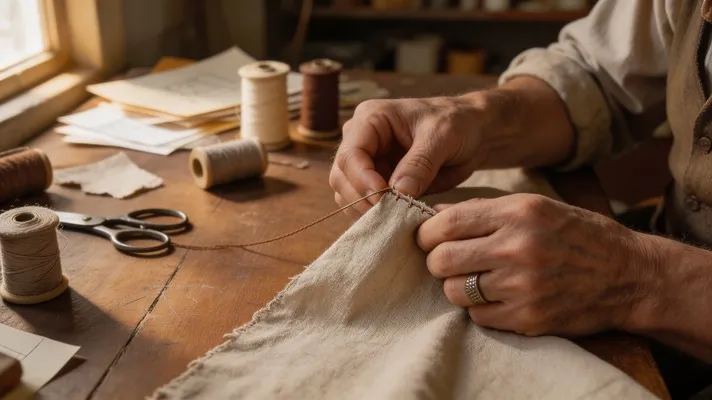
Photo: handmade clothing imperfect stitching artisan textile British fashion studio, via images.stockcake.com
There's a seam on the back of Priya Mehta's favourite jacket that doesn't quite sit straight. It veers, ever so slightly, to the left — a drift of maybe three millimetres that her maker noticed, flagged, and then, after a long pause, decided to keep. Priya, a textile artist from Bristol, didn't ask for a refund. She asked if she could have two.
"It's the bit I look at every time I put it on," she says. "It tells me a human being made this. Not a template. Not a conveyor belt. Someone sat there and stitched this into existence, and the stitch moved, and that movement is still in the cloth."
This is the quiet rebellion currently threading its way through British independent fashion: the deliberate, considered, occasionally joyful embrace of imperfection as a marker of authenticity, craft, and soul.
The Tyranny of the Flawless
For decades, 'quality' in fashion has been shorthand for precision. Even stitching. Matched patterns at the seams. Symmetry at all costs. Fast fashion industrialised this expectation so thoroughly that many of us stopped noticing it — we simply absorbed the idea that a garment with a crooked collar was a failed garment, full stop.
But somewhere between the rise of mass production and the slow, creeping exhaustion with algorithmic sameness, British consumers began to push back. Not loudly, not with manifestos — but with their hands, their wallets, and their increasingly discerning eyes.
Independent designer Cleo Ashworth, who runs a small-batch clothing label from her studio in Sheffield, says the shift has been palpable over the past three years. "People used to apologise on behalf of the piece when they spotted something irregular," she says. "Now they ask about it. They want to know what happened. That curiosity is everything."
Cleo deliberately incorporates what she calls 'honest marks' into her work — slight variations in dye lot, a pocket that sits fractionally lower on one side, a collar point with a barely-there asymmetry. None of it is accidental. All of it is intentional. "There's a difference between a mistake and a decision," she says. "I'm making decisions that look like mistakes. That's the whole point."
The Japanese Thread Running Through British Cloth
Anyone familiar with wabi-sabi — the Japanese aesthetic philosophy that finds beauty in transience and imperfection — will recognise something of its spirit here. But this British iteration has its own distinct flavour. It's less meditative, more mischievous. Less about accepting impermanence and more about actively celebrating the mark of the human hand.
You can see it in the hand-painted buttons appearing on otherwise restrained blazers. In the deliberately uneven hem lengths that recall a child's first attempt at cutting paper. In the block-printed fabrics where the repeat doesn't quite repeat, where the stamp has lifted at one corner and left a ghost of itself behind.
This isn't sloppiness. It's the opposite of sloppiness. It requires enormous confidence to leave the beautiful mistake in.
"Perfection is actually quite easy to fake," says surface pattern designer Nell Cartwright, who works from a studio in Edinburgh. "A machine can be perfect. What a machine cannot do is be interesting in the same way a hand can be interesting. The wobble is the signature."
What the Psychology Tells Us
There's research to support what these makers are feeling instinctively. Studies in consumer psychology have repeatedly shown that handmade goods with visible irregularities are perceived as more valuable and more emotionally resonant than their flawless counterparts — not despite the irregularities, but because of them. The imperfection signals effort. It signals presence. It tells us that someone was there.
In a fashion landscape increasingly dominated by AI-generated trend forecasting and algorithmically optimised product drops, 'someone was there' turns out to be an extraordinarily powerful message.
For many British consumers — particularly those who came of age watching craft culture flourish through lockdown, who learned to sew or knit or print their own textiles during those strange, suspended years — clothing has become a site of genuine meaning-making. What you wear is not just aesthetic self-expression. It's a statement about what you value, what you trust, and what kind of world you want to participate in.
Wearing Your Imperfections With Pride
The movement extends beyond the studio. On the streets of Manchester, Leeds, and London, a growing number of dressers are deliberately seeking out pieces with visible repair, with visible history, with the kind of surface texture that only accumulates through time and use. A darned elbow. A replaced button that doesn't quite match. An embroidered patch over a tear that was never hidden, just transformed.
This is fashion as lived document — clothing that carries evidence of its own story rather than arriving pristine and context-free from a warehouse shelf.
Nat Okafor, a vintage dealer and stylist based in Nottingham, has watched this appetite grow steadily. "The customers who really get it aren't looking for perfect vintage," she says. "They're looking for vintage that's been somewhere. A scorch mark from an iron in 1962 is more interesting than a new garment that looks like it's never been touched."
There's something almost radical in that. In a culture that has spent decades selling us the aspirational ideal of the unworn — the pristine, the untouched, the still-tagged — choosing the marked, the mended, the magnificently imperfect is a quietly subversive act.
The Gorjuss of It All
At its heart, this movement is about curiosity and connection. The crooked seam invites a second look. The off-centre print starts a conversation. The deliberately mismatched buttons ask a question that the wearer gets to answer.
This is fashion not as armour or aspiration, but as invitation — a way of presenting yourself to the world that says: look closer, there's more here than meets the eye.
And perhaps that's the most wonderful thing about the imperfection rebellion. It doesn't ask anything dramatic of us. It just asks us to stop ironing out everything that makes us interesting.
Leave the wonky seam. Keep the ghost print. Wear the jacket with the hem that drifts slightly left.
That drift? That's the whole story.