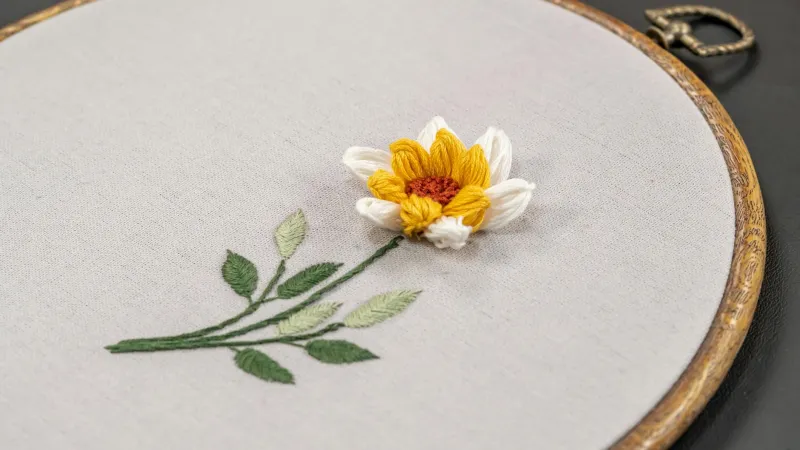
In a converted Victorian mill in Yorkshire, Lucy Waterhouse threads her needle with midnight blue silk and begins to embroider a constellation across the sleeve of a vintage blazer. But these aren't just any stars – they're the exact pattern she saw on the night she met her partner, mapped from memory and translated into French knots that catch the light like tiny promises.
"Each piece tells a story that matters to someone," explains Lucy, whose bespoke embroidered garments have garnered a devoted following among those seeking something more meaningful than high street homogeny. "We're creating modern heirlooms – clothes that carry our personal mythologies forward."
The New Needle Pioneers
Lucy is part of a quietly revolutionary movement sweeping Britain's creative landscape. From the cobbled streets of Edinburgh to the creative quarters of Bristol, a new generation of embroidery artists are transforming the ancient craft into something urgently contemporary. They're not simply reviving traditional techniques – they're reimagining what storytelling can look like when it's worn on the body.
In Glasgow, Morag MacLeod creates what she calls "memory maps" – intricate embroidered landscapes that trace the geography of significant moments. Her latest commission features a walking jacket adorned with the route of a couple's first date, complete with tiny embroidered landmarks: the café where they shared cake, the park bench where they first held hands, the bookshop where they discovered their shared love of poetry.
"People are hungry for authenticity," Morag observes, her fingers dancing across a canvas of midnight velvet. "In a world of fast fashion and digital everything, there's something profound about creating something by hand that will outlast us all."
Folk Tales for the Instagram Age
What sets this new wave apart from traditional embroidery is its fearless embrace of personal mythology. While historical needlework often followed prescribed patterns and motifs, today's embroidery rebels are writing their own visual vocabulary.
Take Priya Sharma, whose London-based studio has become a pilgrimage site for those seeking to transform their stories into stitches. Her "Folk Tales" collection reimagines classic British legends through the lens of contemporary multicultural Britain. A denim jacket might feature Boudicca riding through a field of curry plant and roses, while a silk scarf tells the story of a modern-day selkie navigating the Thames.
"I'm interested in how folklore evolves," Priya explains, pausing from her work on a bomber jacket that depicts urban foxes as mystical guardians. "Every generation creates its own myths. Mine happen to include corner shops and concrete, alongside ancient oak trees and standing stones."
The Slow Stitch Revolution
This embroidery renaissance isn't happening in isolation – it's part of a broader cultural shift towards what practitioners call "slow fashion." In an era where a dress can cost less than a coffee and last about as long, these textile artists are championing permanence over disposability.
"When someone commissions a piece from me, they're not just buying clothing," says James Morrison, whose Cornwall-based practice specialises in what he terms "narrative needlework." His recent work includes a fishing smock embroidered with the names of every boat in a family's maritime history, and a christening gown that maps the migration journey of the wearer's ancestors.
"They're investing in a piece of their own story. These aren't clothes you'll throw away when the season changes – they're garments that become more precious with time."
Beyond the Needle: Building Community
Perhaps most remarkably, this movement is fostering genuine community in an increasingly atomised world. Across Britain, embroidery circles are emerging in unexpected places – from pub back rooms to university campuses, bringing together people who might never otherwise meet.
In Manchester, the "Stitch and Story" collective runs monthly workshops where participants learn to embroider their own narratives. Recent sessions have seen a retired headteacher working alongside a teenage climate activist, both creating pieces that reflect their deepest concerns and hopes.
"There's something magical about sitting in a circle, sharing stories while your hands create," reflects collective founder Sarah Chen. "We're not just learning a craft – we're participating in one of humanity's oldest forms of communication."
The Future of Personal Mythology
As this movement grows, it's attracting attention from unexpected quarters. Fashion schools are introducing narrative embroidery modules, while heritage organisations are commissioning contemporary pieces that bridge past and present. The V&A recently acquired several pieces from this new wave of makers, recognising their cultural significance.
But for the artists themselves, the real magic happens in the quiet moments of creation – when needle meets fabric and story becomes substance. In their hands, embroidery isn't just decoration; it's documentation, mythology, and memory all woven into one.
"Every stitch is an act of faith," Lucy reflects, holding up her constellation blazer to catch the light. "Faith that our stories matter, that beauty has value, that something made by hand carries a different kind of power than something made by machine."
In a world increasingly dominated by the digital and disposable, these thread-wielding rebels are proving that sometimes the most radical act is simply picking up a needle and deciding that your story – whatever it might be – deserves to be told in silk and silver, cotton and gold, one careful stitch at a time.