The Secret Language of Sketches
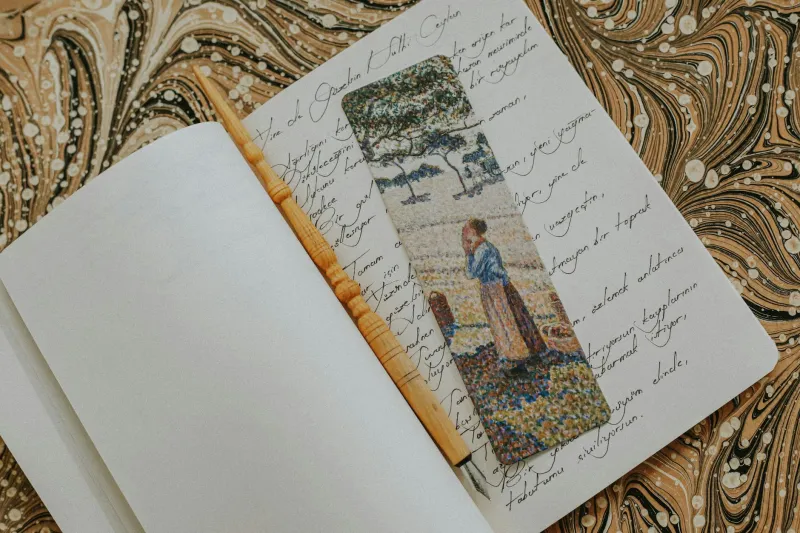
In a converted Victorian terrace in Brighton, Maya Chen holds up a silk scarf printed with what looks like abstract swirls and geometric shapes. Look closer, and you'll recognise the unmistakable loops and dashes of handwritten text—her own morning pages, transformed into a pattern that dances across the fabric like captured thoughts made visible.
"I started journaling during lockdown, like everyone else," Maya explains, her fingers tracing the familiar curves of her own handwriting. "But unlike everyone else, I began to see my pages as more than just therapy. They were blueprints."
Maya is part of a growing movement of British creatives who are mining their personal journals, sketchbooks, and illustrated diaries for fashion inspiration. These aren't your typical fashion designers—they're emotional archaeologists, digging through layers of daily observations, midnight musings, and coffee-stained revelations to create textiles that tell deeply personal stories.
From Breakfast Thoughts to Blazer Prints
The process is beautifully unconventional. Take Finn O'Sullivan, a textile artist from Glasgow whose morning ritual involves coffee, toast, and filling three pages of stream-of-consciousness writing. What started as a mindfulness practice has evolved into a textile printing business that transforms his daily thoughts into limited-edition fashion pieces.
"My journal entries about the weather, my commute, my terrible attempts at cooking—they all become part of the design language," Finn says, showing me a bomber jacket printed with what appears to be rain patterns but is actually his handwritten descriptions of Scottish drizzle from seventeen different Tuesday mornings.
The beauty lies in the layers of meaning. To most people, it's an abstract print. To Finn, it's a wearable diary of his relationship with his city's notorious weather. To the person who buys it, it becomes something else entirely—a piece of someone else's inner world that somehow speaks to their own.
The Intimacy Economy
This trend speaks to something profound about how we want to dress in 2024. In an era of mass production and algorithmic recommendations, there's something deeply appealing about wearing something that began as a private moment between a person and their diary.
Dr. Sarah Whitfield, a fashion psychologist at Central Saint Martins, suggests this movement reflects our hunger for authenticity in fashion. "When someone wears a print that originated from another person's journal, they're participating in an intimate exchange. They're carrying someone's vulnerability, their humanity, on their body."
 Photo: Central Saint Martins, via stantonwilliams.com
This intimacy extends to the makers themselves. For many, the transition from private journaling to public fashion feels like the ultimate act of creative courage. "There's something terrifying about wearing your own thoughts," admits Priya Patel, a London-based designer whose illustrated diary entries about navigating life as a second-generation immigrant have become a sought-after print collection.
Regional Rhythms
What's fascinating is how different regions of Britain are producing distinctly different journaling styles that translate into unique fashion aesthetics. Northern creators tend toward more industrial, graphic approaches—think Manchester's Zoe Williams, whose technical drawings mixed with poetry create prints that look like beautiful blueprints for emotions.
Meanwhile, the Southwest is producing softer, more organic interpretations. Cornwall's Tom Hartley fills his journals with observations about tides, seabirds, and coastal light, creating textiles that feel like wearing the rhythm of the sea.
Even London's scene is fractured into micro-movements: East London's journal-to-fashion artists lean heavily into social commentary and urban observations, while South London creators are exploring more introspective, therapeutic approaches to wearable diary art.
The Technical Magic
The transformation from page to pattern requires both artistic vision and technical skill. Most creators work with digital printing techniques that can capture the nuanced textures of pencil marks, ink bleeds, and paper grain. Some, like Cardiff's Emma Davies, deliberately incorporate the "mistakes"—coffee rings, smudged ink, torn pages—as part of the design's authenticity.
"The imperfections are where the humanity lives," Emma explains, showing me a dress printed with pages from her journal about her grandmother's final months. The tear stains are still visible in the print, transformed into abstract watermarks that add emotional depth to the pattern.
Wearing Your Truth
Perhaps what's most striking about this movement is how it challenges traditional notions of fashion privacy. These creators are literally wearing their hearts on their sleeves—and asking others to do the same.
For the people who buy these pieces, there's often a profound recognition. "I bought a top with someone else's diary pages printed on it, and somehow it felt like wearing my own thoughts," says Manchester shopper Lisa Thompson. "It was like they'd written down feelings I didn't even know I had."
This is fashion as emotional archaeology, where the personal becomes universal through the simple act of putting it on cloth. In a world increasingly dominated by artificial intelligence and algorithmic creativity, these journal-to-fashion artists are proving that the most powerful designs still come from the most human place of all: the honest, messy, beautiful contents of our own minds.
As Maya in Brighton puts it, adjusting her handwriting-printed scarf against the sea breeze: "When you wear your own thoughts, you remember who you are. When you wear someone else's thoughts, you remember who you could become."